Tissue Repair Research Peptides: A Cluster Overview
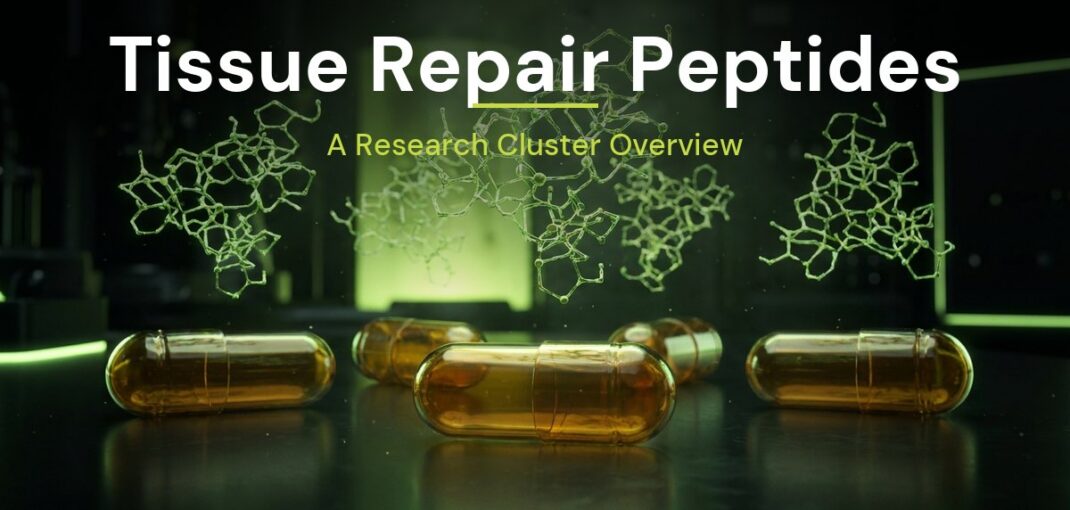
Tissue repair peptides are one of the most actively researched categories of peptides, and they form one of the three research clusters Captide Labs organizes its catalog around. This overview introduces the compounds in the tissue repair cluster — BPC-157, TB-500, GHK-Cu, and combination blends — and explains how the capsule-first format relates to the research literature on each. It makes no claims about effects in humans; all compounds discussed are supplied strictly for laboratory and research use only and are not approved for human use by the FDA or other regulatory authorities.
What “tissue repair peptides” refers to
The phrase tissue repair peptides describes a group of peptides studied in preclinical models of wound healing, connective-tissue repair, and related regenerative processes. The grouping is a research convenience rather than a regulatory category — these compounds share an overlapping body of literature around mechanisms like angiogenesis (new blood-vessel formation), collagen organization, and cell migration. Importantly, the evidence base across this cluster is overwhelmingly preclinical, drawn from animal and in vitro studies, with limited human data. Researchers should treat these as research tools whose profiles are defined by laboratory studies, not by established human outcomes.
The compounds in the cluster
BPC-157. A synthetic pentadecapeptide frequently studied in tissue-repair and gastrointestinal models, and notable in the oral-research context because the literature describes it as unusually stable in gastric juice. It anchors the cluster as the most-searched of the tissue repair peptides. For a deeper look, see our dedicated BPC-157 capsules overview.
TB-500 (thymosin β4 fragment). TB-500 is associated with thymosin β4, a 43-amino-acid peptide widely studied in repair contexts. The preclinical literature describes mechanisms including cell migration, angiogenesis, and collagen organization. One rat study of ligament injury reported that thymosin β4 treatment produced significantly better biomechanical properties in healing tissue at four weeks compared with controls (PubMed). As with the rest of the cluster, the human evidence directly relevant to musculoskeletal applications remains limited. PubMed
GHK-Cu (copper tripeptide). GHK-Cu is a glycyl-L-histidyl-L-lysine copper complex studied for its role in extracellular-matrix remodeling. Reviews describe it acting as both a signal and a carrier peptide that, in preclinical work, promotes collagen, elastin, and proteoglycan synthesis while modulating matrix remodeling during healing (PRIME Journal review). It rounds out the cluster as the copper-peptide entry. Prime-journal
Blends. Combination products — for example a BPC-157 + TB-500 blend — pair compounds from the cluster in a single research preparation. These are studied where a research design calls for evaluating more than one compound together rather than in isolation.
Why the capsule format fits this cluster
The broad challenge in oral peptide research is gastrointestinal stability — most peptides degrade quickly in the digestive environment. Within the tissue repair peptides cluster, BPC-157 in particular is discussed for its reported gastric stability, which is part of why the oral route is studied for it. The capsule format standardizes the quantity of material per unit and removes the reconstitution and liquid-handling steps that vial and spray formats require, reducing a source of handling variability in repeatable research.
This is the niche Captide Labs concentrates on: the capsule format and the body of oral-peptide research around these compounds. Where a research question concerns mucosal or intranasal models instead, the same cluster compounds are also available in spray format, so the format can be matched to the research design. For how the formats compare in general, see our peptide capsules vs. other formats guide.
Capsule and spray formats within the cluster
Each compound in the tissue repair peptides cluster is offered in more than one format, and the format frames a different set of research variables. Capsules deliver a standardized fixed quantity per unit with no reconstitution, which suits research designs concerned with the oral route and with repeatable dosing units. Sprays present a pre-prepared liquid relevant to mucosal or intranasal research models. Lyophilized vials, common across the wider peptide market, give maximum control over concentration but introduce reconstitution and sterile-handling steps where error can enter. Because the cluster spans compounds with different research contexts, the ability to choose a format per compound matters more here than in a single-compound catalog. A researcher studying oral bioavailability will reach for capsules, while one working in an intranasal model will reach for a spray of the same compound.
How researchers approach the cluster
Researchers working across tissue repair peptides generally select compounds based on the specific model and pathway under study rather than treating the cluster as interchangeable. BPC-157 appears most often in gastrointestinal and general tissue-repair models; thymosin β4 / TB-500 features in connective-tissue and wound-healing literature; GHK-Cu is concentrated in extracellular-matrix and skin-remodeling research. Blends serve designs that evaluate compounds in combination. Matching the compound to the research question is the same principle that applies to format selection — the goal is fit, not familiarity.
Handling and storage across the cluster
Beyond identity and purity, practical handling affects reproducibility when working with tissue repair peptides. Capsules remove the per-use measurement step that powder and vial formats require, which reduces a meaningful source of variability for designs that depend on consistent quantities. Storage should follow supplier specifications and general good practice for research peptides, keeping material sealed and protected from heat, moisture, and light until use. These handling considerations apply across the cluster regardless of which compound is under study, and they are one reason the capsule format has become a focal point for oral-route research within this group.
Regulatory and compliance context
None of the tissue repair peptides in this cluster are approved for human use by the FDA or comparable authorities, and several have drawn regulatory attention. They are supplied for laboratory and research applications only. Anyone sourcing these compounds should understand that their legitimate use is confined to research settings, and that no health, therapeutic, or performance claims can accompany them. This is not a limitation on the research value of the compounds; it is simply the framework within which they are legitimately studied and supplied.
Sourcing tissue repair peptides
As with any research peptide, the variables that matter most are identity and purity, and those come down to sourcing and analytical testing rather than the format or the cluster label. When evaluating a supplier of tissue repair peptides, look for:
- Third-party analytical testing (e.g. HPLC) confirming identity and purity, with documentation available on request.
- A stated purity specification rather than vague quality claims.
- Clear research-use-only labeling and the absence of health, therapeutic, or performance claims — both a compliance signal and a credibility signal.
Captide Labs supplies the tissue repair cluster — BPC-157, TB-500, GHK-Cu, and blends — in capsule and spray formats, each with third-party testing documentation. Browse the full peptide capsule catalog to see the tissue repair, metabolic, and cognitive research clusters.
All Captide Labs products are intended for laboratory and research use only. They are not for human consumption and are not intended to diagnose, treat, cure, or prevent any disease. The compounds discussed are not approved for human use by the FDA or other regulatory authorities.