BPC-157 Capsules: A Research Overview
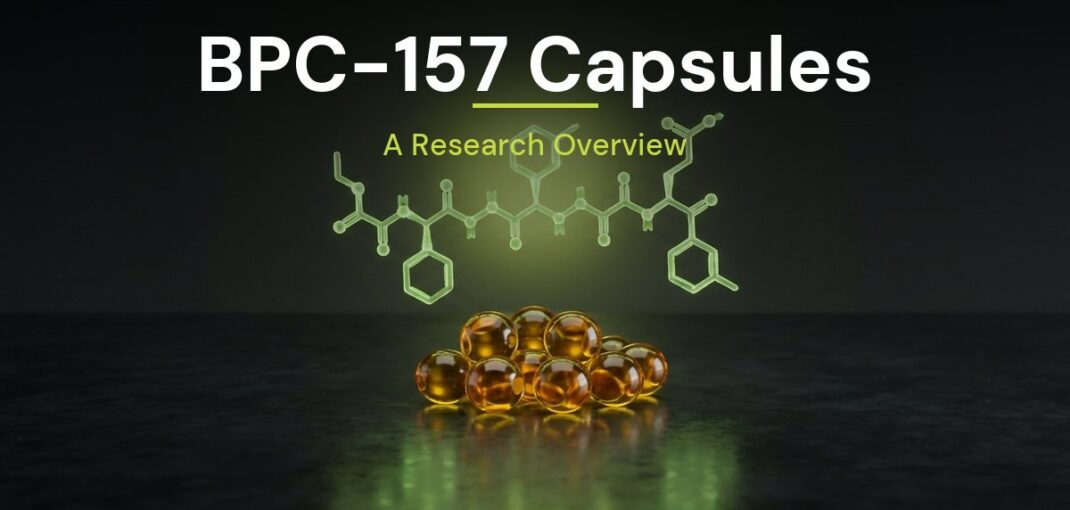
BPC-157 capsules are among the most frequently searched oral research peptide formats, and for researchers focused on the compound, the capsule presentation raises a specific set of considerations around stability, handling, and the oral-research context. This overview covers what BPC-157 is at a structural level, why the capsule format is relevant to its research literature, and what matters when sourcing it. It makes no claims about effects in humans; BPC-157 is supplied strictly for laboratory and research use only and is not approved for human use by the FDA or other regulatory authorities.
What BPC-157 is
BPC-157 — “Body Protection Compound 157” — is a synthetic pentadecapeptide, meaning a chain of fifteen amino acids. It was originally identified as a partial sequence derived from human gastric juice, and its amino acid sequence is considered essential to its activity, as reviewed in the literature on the compound. As one literature and patent review notes, BPC-157 is a pentadecapeptide isolated from human gastric juice that has shown a range of effects in preclinical models, while remaining unapproved by the FDA due to the absence of comprehensive human clinical studies (Pharmaceuticals review, MDPI). nih
A structural detail relevant to the capsule format: the same review notes the sequence renders the peptide notably stable in water and in gastric juice — a property that distinguishes BPC-157 from many peptides that degrade rapidly in the gastrointestinal environment.
Why the capsule format is relevant to BPC-157
The general challenge with oral peptide research is gastrointestinal stability — most peptides are broken down quickly by stomach and intestinal conditions. BPC-157 is frequently discussed in that context precisely because the literature describes it as unusually stable in gastric juice. That makes BPC-157 capsules a natural focal point for researchers studying the oral route, since the compound’s reported gastric stability is one of the recurring themes in its research profile.
This is the niche Captide Labs concentrates on: the capsule format and the body of oral-peptide research around it. For a researcher whose questions concern oral presentation, fixed-dose handling, or the gastric-stability properties specific to this compound, BPC-157 capsules are the relevant starting point rather than an afterthought. Working with BPC-157 capsules also removes the reconstitution step that vial-based research requires, which can reduce a source of handling variability.
What the research literature covers
BPC-157 has an extensive preclinical literature, almost entirely in animal and in vitro models. Reviews describe work spanning tissue-repair models, gastrointestinal research, and central nervous system models, with proposed mechanisms involving angiogenic pathways. A recent narrative review of the musculoskeletal literature summarizes that BPC-157 activates overlapping pathways including VEGFR2 and nitric oxide synthesis, and that despite robust preclinical evidence there remains a critical need for well-designed human trials (scoping review, PubMed). PubMed
Two points are worth emphasizing for a research audience: the evidence base is overwhelmingly preclinical, and there is minimal human data. Researchers evaluating BPC-157 capsules should treat the compound as a research tool whose profile is defined by animal and in vitro studies, not by established human outcomes. The breadth of the preclinical literature is one reason BPC-157 capsules attract sustained research interest even though clinical confirmation remains absent.
How BPC-157 capsules compare to other formats
Researchers encountering BPC-157 will find it offered as a lyophilized powder in vials, in reconstituted liquids, and as capsules. Each format frames a different set of research variables. Vials give maximum control over concentration but require accurate reconstitution and sterile technique, introducing steps where error can enter. Liquid and spray formats remove the reconstitution step but fix the concentration at the point of manufacture. BPC-157 capsules sit between these by delivering a standardized, fixed quantity per unit with no liquid handling — which is why they suit research designs concerned with the oral route and with repeatable dosing units. The choice is best matched to the research question rather than to convenience alone.
Handling and storage considerations
Beyond identity and purity, the practical handling of BPC-157 capsules matters for reproducible research. Capsules standardize the quantity of material per unit, which removes the per-use measurement step that powder and vial formats require. For research designs that depend on consistent, repeatable quantities, this standardization reduces a meaningful source of variability. Storage should follow the supplier specifications and general good practice for research peptides — keeping material sealed and away from heat, moisture, and light until use.
Regulatory and compliance context
BPC-157 is not approved for human use by the FDA or comparable authorities, and its status has drawn regulatory attention. It is supplied for laboratory and research applications only. Anyone sourcing BPC-157 capsules should understand that the compound’s legitimate use is confined to research settings, and that no health, therapeutic, or performance claims can accompany it.
Common questions about BPC-157 capsules
A frequent question is whether the capsule format affects the compound itself. The capsule shell functions primarily as a container that standardizes the amount of material per unit, so the relevant variables remain identity and purity of the material inside. Another common question concerns the gastric-stability property the literature describes, which is part of why the oral route is studied for this particular pentadecapeptide. A third question is about documentation — a credible supplier of BPC-157 capsules should be able to provide third-party analytical results on request.
Sourcing BPC-157 capsules
As with any research peptide, the variables that matter most are identity and purity — and those come down to sourcing and analytical testing rather than the format itself. A capsule is only as reliable as the material inside it. When evaluating a supplier of BPC-157 capsules, look for:
- Third-party analytical testing (e.g. HPLC) confirming identity and purity, with documentation available.
- A stated purity specification rather than vague quality claims.
- Clear research-use-only labeling and the absence of health or therapeutic claims — both a compliance signal and a credibility signal.
Captide Labs supplies BPC-157 capsules with third-party testing documentation, as part of its tissue-repair research cluster. Browse the full peptide capsule catalog, see the related tissue repair research peptides cluster, or read our peptide capsules vs. other formats guide for how the capsule format compares to vials and sprays.
All Captide Labs products are intended for laboratory and research use only. They are not for human consumption and are not intended to diagnose, treat, cure, or prevent any disease. BPC-157 is not approved for human use by the FDA or other regulatory authorities.