
5-AMINO-1MQ
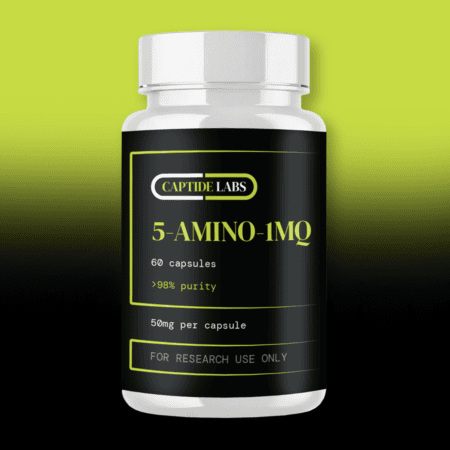
5-Amino-1MQ (5-amino-1-methylquinolinium) is a small-molecule selective inhibitor of nicotinamide N-methyltransferase (NNMT). Unlike most compounds in this catalog, it is not a peptide; it is a quinolinium-class small molecule developed through a structure–activity-relationship program targeting NNMT for metabolic-disease research. The active species is the cation C₁₀H₁₁N₂⁺ (PubChem CID 950107); the compound is most commonly supplied as the iodide salt, catalogued under CAS number 42464-96-0, with a molecular formula of C₁₀H₁₁IN₂ and a molecular weight of approximately 286.11 g/mol. A defining physicochemical feature is its membrane permeability, which enables the small molecule to enter intact cells and inhibit intracellular NNMT — a property that distinguished it from earlier, more polar NNMT-inhibitor scaffolds.
5-Amino-1MQ has been studied predominantly in rodent models and in vitro adipocyte systems, where investigators have examined NNMT enzymology, adipose-tissue methylation biology, and NAD+ salvage flux. The compound is supplied here strictly as a research-use chemical for in vitro and laboratory investigation of these pathways. 5-Amino-1MQ is not approved by the FDA, EMA, or any other regulatory authority for any indication, and no adequately powered human clinical trials have established efficacy or a safety profile.
Important note on the evidence base: The peer-reviewed 5-Amino-1MQ literature consists of small-molecule medicinal-chemistry characterization and in vivo rodent work, primarily in diet-induced obesity models, produced by a small number of research groups. No completed Phase 2 or Phase 3 clinical trials of 5-Amino-1MQ in human participants exist, and no NNMT inhibitor has reached regulatory approval for any indication. Researchers consulting this page should weight the evidence accordingly and refer to the primary literature in the References section for full methodological detail.
Available Products
Mechanism of Action
The mechanistic literature on 5-Amino-1MQ centers on selective inhibition of nicotinamide N-methyltransferase, with downstream metabolic effects mediated through changes in cellular methyl-donor availability and NAD+ precursor flux. The pathways described below are drawn from preclinical work and have not been independently confirmed in human clinical studies.
NNMT enzyme inhibition
Nicotinamide N-methyltransferase catalyzes the transfer of a methyl group from S-adenosyl-L-methionine (SAM) to nicotinamide, producing 1-methylnicotinamide (1-MNA) and S-adenosyl-L-homocysteine. The reaction consumes SAM (the universal cellular methyl donor) and nicotinamide (an NAD+ salvage precursor). In the foundational structure–activity study, investigators characterized 5-Amino-1MQ as a substrate-site-targeting, selective NNMT inhibitor with low-micromolar potency (reported IC₅₀ of approximately 1.2 µM), and demonstrated on-target engagement in cultured adipocytes through reductions in 1-MNA without affecting related methyltransferases or NAD+ salvage enzymes [1].
Methyl-donor and NAD+ precursor pool effects
Because NNMT consumes both SAM and nicotinamide, its inhibition is reported to increase the cellular availability of both. The genetic precedent for this mechanism comes from a study in which adipocyte-specific NNMT knockdown in mice increased adipocyte energy expenditure and protected against diet-induced obesity, an effect interpreted as elevated methyl-donor availability and altered adipocyte gene-expression programs [2]. The retained nicotinamide is, in turn, available for entry into the NAD+ salvage pathway, positioning NNMT inhibition within the broader cellular-energetics and NAD+ research framework.
Adipose-tissue methylation biology
NNMT is reported to be upregulated in white adipose tissue in obesity, and its enzymatic activity has been implicated in maintaining the adipocyte fat-storage phenotype through SAM-dependent processes. In the pivotal in vivo study, systemic administration of 5-Amino-1MQ to diet-induced obese mice produced reductions in body weight and white adipose mass without changes in food intake, alongside decreased adipocyte size and lowered plasma total cholesterol — an effect profile the investigators interpreted as pharmacological validation of the earlier NNMT-knockdown phenotype [3].
NAD+ salvage and the metabolic-aging research framing
Because NNMT consumes nicotinamide, its inhibition has been proposed to increase the nicotinamide available for entry into the NAD+ salvage pathway via nicotinamide phosphoribosyltransferase (NAMPT). This connection has positioned NNMT inhibition within the broader cellular-aging and sirtuin-pathway research framework, alongside NAD+ precursors such as nicotinamide riboside and nicotinamide mononucleotide. A conceptual distinction frequently drawn in the literature is that NAD+ precursors increase system-wide substrate supply, whereas NNMT inhibition is hypothesized to reduce local nicotinamide loss in tissues where the enzyme is overexpressed — predominantly white adipose tissue. The magnitude of any NAD+-elevating effect of NNMT inhibition in vivo, and its contribution to the metabolic phenotype relative to the methylation effects, remains an active area of research and has not been resolved in human studies.
None of the mechanisms summarized here have been independently verified in adequately powered human clinical trials of 5-Amino-1MQ specifically.
Forms and Use in the Research Literature
The amount ranges and routes described below reflect the protocols used in the published preclinical 5-Amino-1MQ literature. They are reported strictly for research-reference purposes and do not constitute administration recommendations of any kind.
Diet-induced obesity protocol. In the pivotal rodent study, adult C57BL/6 mice on a high-fat diet received 5-Amino-1MQ at amounts in the milligram-per-kilogram range by subcutaneous administration over an 11-day treatment period, with endpoints including body weight, white adipose mass, adipocyte size, and plasma lipid measures. The investigators reported no overt toxicity at the studied amounts [3].
In vitro characterization. Cell-culture work has characterized 5-Amino-1MQ as a competitive, membrane-permeable NNMT inhibitor in cultured 3T3-L1 adipocytes, with measurable reductions in lipogenesis and 1-MNA production at micromolar concentrations, and a selectivity profile assessed against related SAM-dependent methyltransferases [1].
Pharmacokinetic profile. The membrane-permeable small-molecule structure produces oral and systemic exposure in rodent models, distinguishing 5-Amino-1MQ from peptide compounds. Published human pharmacokinetic data are not available.
Stability and storage. 5-Amino-1MQ iodide is typically supplied as a solid and stored frozen, protected from light, with reconstituted solutions kept refrigerated. Each lot supplied by Captide Labs is accompanied by a batch-specific Certificate of Analysis documenting identity and purity by HPLC.
Adverse-event profile. No human clinical-trial adverse-event database exists for 5-Amino-1MQ. The available preclinical literature reported no overt toxicity at the studied amounts but is not equivalent to a regulated Phase 1 safety dataset; safety in humans has not been established.
References
- Neelakantan H, Wang HY, Vance V, Hommel JD, McHardy SF, Watowich SJ. Structure-Activity Relationship for Small Molecule Inhibitors of Nicotinamide N-Methyltransferase. J Med Chem. 2017;60(12):5015–5028. doi:10.1021/acs.jmedchem.7b00389 · PubMed: 29059531
- Kraus D, Yang Q, Kong D, et al. Nicotinamide N-methyltransferase knockdown protects against diet-induced obesity. Nature. 2014;508(7495):258–262. doi:10.1038/nature13198 · PubMed: 24717514
- Neelakantan H, Vance V, Wetzel MD, et al. Selective and membrane-permeable small molecule inhibitors of nicotinamide N-methyltransferase reverse high fat diet-induced obesity in mice. Biochem Pharmacol. 2018;147:141–152. doi:10.1016/j.bcp.2017.11.007 · PubMed: 29155147