
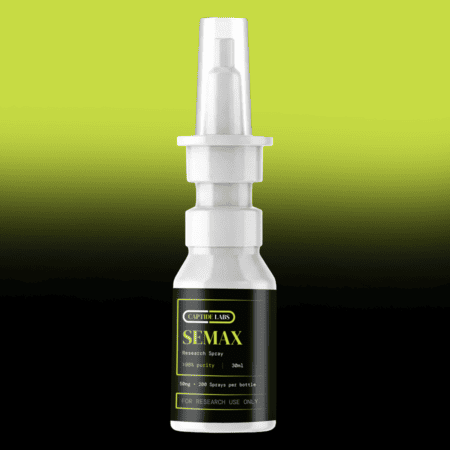
SEMAX
Semax is a synthetic heptapeptide with the amino-acid sequence Met-Glu-His-Phe-Pro-Gly-Pro (MEHFPGP). It is an analogue of the ACTH(4-7) fragment of adrenocorticotropic hormone — the short N-terminal segment associated with the hormone’s nootropic activity — fused with a C-terminal Pro-Gly-Pro tripeptide that confers resistance to enzymatic degradation. The compound is catalogued under CAS number 80714-61-0, with a molecular formula of C₃₇H₅₁N₉O₁₀S and a molecular weight of approximately 813.9 g/mol (PubChem CID 9811102). It was developed at the Institute of Molecular Genetics of the Russian Academy of Sciences — the same program that produced Selank — using the same design strategy of stabilizing a short biologically active sequence with a Pro-Gly-Pro motif.
Semax has been studied in cell-culture, animal, and human research, predominantly within the Russian research program from which it originates, where it is an approved prescription pharmaceutical listed on the Russian List of Vital and Essential Drugs. It is supplied here strictly as a research-use chemical for in vitro and laboratory investigation. It is not approved by the FDA, EMA, or any other Western regulatory authority for any indication.
Important note on the evidence base: A substantial portion of the published Semax literature originates from a single national research program and is published in Russian-language journals; while this includes a meaningful clinical track record in its country of origin, large independent Western randomized controlled trials are not available, and much of the strongest mechanistic work is preclinical. Researchers should weight the single-source character of much of the evidence accordingly and consult the primary literature in the References section.
Available Products
Mechanism of Action
The research literature on Semax centers on rapid upregulation of neurotrophic factors and neuroprotective effects in models of cerebral ischemia. The pathways below are drawn predominantly from the originating program’s preclinical and clinical work and are presented as mechanistic characterization, not therapeutic claims.
ACTH-fragment lineage
Semax derives from the ACTH(4-7) sequence, the portion of adrenocorticotropic hormone associated with effects on learning and memory but separated from the hormone’s corticotropic (adrenal-stimulating) activity. By isolating the neuroactive fragment and stabilizing it with the Pro-Gly-Pro extension, the peptide was designed to retain central effects while resisting the rapid proteolysis that limits native ACTH fragments, reaching the central nervous system rapidly after administration in research models [1].
BDNF/NGF and TrkB upregulation
The most-characterized mechanism attributed to Semax is rapid upregulation of the neurotrophins brain-derived neurotrophic factor (BDNF) and nerve growth factor (NGF) and of the BDNF receptor TrkB. In rat hippocampus, a single application was reported to increase BDNF protein levels, TrkB phosphorylation, and exon-specific BDNF and TrkB mRNA, accompanied by behavioral changes in conditioned-response tasks. This neurotrophin-system modulation is the proposed molecular basis for the cognitive and neuroprotective effects described in the literature [1].
Neuroprotective and anti-inflammatory signalling
In models of cerebral ischemia, Semax has been reported to activate neurotrophic-factor and neurotransmission-related gene expression while suppressing pro-inflammatory mediators. Transcriptomic studies of ischemic rat cortex reported that the peptide predominantly influenced genes related to the immune and inflammatory response, and protein-level work implicated mediators such as CREB, MMP-9, c-Fos, and JNK, alongside effects on vascular endothelial growth factor (VEGF) expression and neuronal survival under hypoxia [2]. The peptide also modulates dopaminergic and serotonergic signalling in research models.
None of the mechanisms summarized here have been verified in large independent Western clinical trials.
Forms and Use in the Research Literature
The information below reflects how Semax appears in the published literature. It is reported strictly for research-reference purposes and does not constitute administration recommendations of any kind.
Neurotrophin and behavioral models. Animal work has used Semax at microgram-per-kilogram amounts to examine BDNF/NGF and TrkB expression in the hippocampus and cortex and to assess learning and memory endpoints, including conditioned-avoidance paradigms [1].
Cerebral-ischemia and transcriptomic research. A significant body of work has examined Semax in rodent models of focal cerebral ischemia (such as middle cerebral artery occlusion), using genome-wide transcriptome analysis to characterize its effects on immune, inflammatory, and neurotrophic gene-expression programs — the research context most associated with its approved use in its country of origin [2].
Clinical research record. In its country of origin, Semax has been studied and used clinically in ischemic-stroke recovery and cognitive-impairment contexts, and multiple studies report effects on attention, memory, and learning in both healthy volunteers and patients. As noted above, this record is largely single-source and not replicated in independent Western trials.
Capsule format. This product is supplied by Captide Labs in capsule form, consistent with the brand’s capsule-first catalog. Researchers should note that the published Semax literature predominantly used intranasal administration, so oral or encapsulated delivery represents a distinct research variable, and oral bioavailability of this peptide is not well characterized.
Stability and storage. Semax is supplied as a lyophilized powder, typically stored frozen, protected from light, with reconstituted solutions kept cold and used promptly. The Pro-Gly-Pro extension confers greater stability than native ACTH fragments, and the methionine residue warrants protection from oxidation. Each lot supplied by Captide Labs is accompanied by a batch-specific Certificate of Analysis documenting identity and purity by HPLC.
Adverse-event profile. The Russian clinical literature reported a favourable tolerability profile, but adequately powered independent safety data is not available, and safety for any use outside that research context has not been established to a Western regulatory standard. Because Semax derives from an ACTH fragment, its separation from corticotropic activity is a relevant characterization point, though full endocrine effects are not comprehensively studied.
References
- Dolotov OV, Karpenko EA, Inozemtseva LS, et al. Semax, an analog of ACTH(4-10) with cognitive effects, regulates BDNF and trkB expression in the rat hippocampus. Brain Res. 2006;1117(1):54–60. doi:10.1016/j.brainres.2006.07.108 · PubMed: 16996037
- Medvedeva EV, Dmitrieva VG, Povarova OV, et al. The peptide semax affects the expression of genes related to the immune and vascular systems in rat brain focal ischemia: genome-wide transcriptional analysis. BMC Genomics. 2014;15(1):228. doi:10.1186/1471-2164-15-228 · PubMed: 24661624
- Shadrina M, Kolomin T, Agapova T, et al. Comparison of the temporary dynamics of NGF and BDNF expression in rat hippocampus, frontal cortex, and retina under Semax action. J Mol Neurosci. 2010;41(1):30–35. doi:10.1007/s12031-009-9270-z · PubMed: 19705087