
DIHEXA
Dihexa (developmental code PNB-0408) is a synthetic oligopeptide derived from angiotensin IV, studied for its proposed effects on the hepatocyte growth factor (HGF) / c-Met signalling system. Its chemical structure is N-hexanoic-Tyr-Ile-(6)-aminohexanoic amide, catalogued under CAS number 1401708-83-5, with a molecular formula of C₂₇H₄₄N₄O₅ and a molecular weight of approximately 504.66 g/mol. It was developed at Washington State University as a metabolically stabilized angiotensin IV analogue engineered to overcome the poor stability and limited blood-brain-barrier penetration of earlier compounds in that class; it is reported to be orally active with blood-brain-barrier permeability.
Dihexa has been studied exclusively in preclinical systems — cultured neurons and rodent models. It is supplied here strictly as a research-use chemical for in vitro and laboratory investigation. It is not approved by the FDA, EMA, or any other regulatory authority for any indication, and no human clinical trials of Dihexa have been published.
Important note on the evidence base — please read carefully: The foundational published characterization of Dihexa’s mechanism has significant integrity problems that researchers must be aware of. Two key papers from the originating laboratory — the 2012 study first describing the HGF-dimerization-mimetic mechanism and the 2014 follow-up proposing HGF/c-Met-dependent procognitive effects — were both formally retracted in April 2025 following Notices of Concern issued in 2021. A third foundational behavioral paper from 2013 carries a Notice of Concern. As a result, the originating lab’s primary data should not be treated as settled. The HGF/c-Met mechanism has since received some independent corroboration from other research groups (including a 2021 transgenic-mouse study), but the overall evidence base for Dihexa is weaker than its early literature suggested. This page is written to reflect that reality. Researchers should consult the primary literature, including the retraction notices, directly.
Available Products
Mechanism of Action
The proposed mechanism for Dihexa centers on potentiation of HGF signalling at the c-Met receptor. The descriptions below reflect the proposed model as it appears in the literature, with the important caveat that the originating laboratory’s primary mechanistic data has been retracted, and the model rests substantially on subsequent independent replication.
The angiotensin IV / HGF connection
Dihexa derives from angiotensin IV, a peptide of the renin-angiotensin system with documented pro-cognitive effects in animal models. The conceptual bridge to HGF rests on observed functional similarities and reported sequence homology between angiotensin IV and the “hinge” linker region of HGF, which led researchers to hypothesize that angiotensin IV analogues might act through the HGF/c-Met system rather than through a distinct AT4 receptor [1].
Proposed HGF/c-Met potentiation
In the proposed model, Dihexa binds HGF with high affinity (a dissociation constant on the order of picomolar has been reported) and acts as an allosteric potentiator, augmenting HGF’s ability to activate its receptor c-Met at concentrations of HGF that would otherwise be subthreshold, rather than activating the receptor directly on its own. Downstream of c-Met activation, the literature describes engagement of the PI3K/Akt and MAPK/ERK signalling cascades associated with neurite outgrowth, dendritic spine formation, and synaptogenesis. It is important to reiterate that the original experimental data underpinning this model has been retracted; the mechanism’s current standing depends on independent replication by other groups [2].
Theoretical oncogenic-risk consideration
Because the HGF/c-Met pathway is involved in cell proliferation and is well documented in cancer biology, sustained potentiation of this pathway carries a theoretical oncogenic-risk consideration that is frequently noted in the Dihexa literature. This concern is theoretical and has not been characterized in any controlled study, but it is relevant context for any research use [3].
None of the mechanisms summarized here have been verified in human clinical trials, and the foundational preclinical data has been subject to formal retraction.
Forms and Use in the Research Literature
The information below reflects how Dihexa appears in the published preclinical literature. It is reported strictly for research-reference purposes and does not constitute administration recommendations of any kind.
Rodent cognitive models. Preclinical work reported that orally administered Dihexa, in the milligram-per-kilogram range, improved performance in spatial-learning tasks (such as the Morris water maze) in aged and scopolamine-treated rats, with reported oral bioavailability of roughly 38 percent and blood-brain-barrier penetration. Several of the originating behavioral reports now carry Notices of Concern, and the most robust current support comes from a 2021 study in a transgenic Alzheimer’s-model mouse conducted by an independent group, which reported restored spatial learning and activation of the PI3K/AKT pathway [3].
In vitro neuronal models. Cultured-neuron work described induction of dendritic spinogenesis at very low (picomolar to nanomolar) concentrations, an observation that contributed to early descriptions of Dihexa as an extraordinarily potent neurotrophic compound. As noted, key primary data of this kind from the originating lab has been retracted.
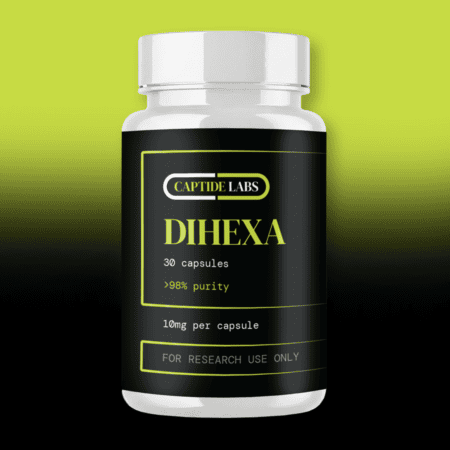
Capsule format. This product is supplied by Captide Labs in capsule form, consistent with the brand’s capsule-first catalog and with Dihexa’s reported oral activity in rodent models.
Stability and storage. Dihexa is typically supplied as a solid and stored frozen, protected from light, with stock solutions prepared in an organic solvent such as DMSO for low concentrations. Each lot supplied by Captide Labs is accompanied by a batch-specific Certificate of Analysis documenting identity and purity by HPLC.
Adverse-event profile. No human clinical-trial adverse-event database exists for Dihexa, and long-term safety has not been established in any species. The theoretical oncogenic-risk consideration described above, combined with the compromised state of the foundational evidence base, warrants particular caution in interpreting this compound’s research literature.
References
- Wright JW, Harding JW. The Brain Renin-Angiotensin System: A Diversity of Functions and Implications for CNS Diseases. Pflugers Arch. 2013;465(1):133–151. doi:10.1007/s00424-012-1102-2 · PubMed: 22535211
- Benoist CC, Kawas LH, Zhu M, et al. The procognitive and synaptogenic effects of angiotensin IV-derived peptides are dependent on activation of the hepatocyte growth factor/c-Met system. J Pharmacol Exp Ther. 2014;351(2):390–402. [RETRACTED — see retraction notice: J Pharmacol Exp Ther. 2025;392(4):103567] doi:10.1124/jpet.114.218735 · Retraction notice PubMed: 40312093
- Because Dihexa’s foundational mechanistic and behavioral papers have been retracted or flagged with Notices of Concern, the current state of the evidence is best assessed directly from the primary record rather than from a single citation. Researchers should consult current PubMed listings for Dihexa, including the April 2025 retraction notices and subsequent independent replication work (such as 2021 transgenic-mouse studies of HGF/c-Met-pathway modulation), to evaluate the present standing of the literature. PubMed search: https://pubmed.ncbi.nlm.nih.gov/?term=dihexa