
NAD+
NAD+ (nicotinamide adenine dinucleotide) is a fundamental endogenous coenzyme present in all living cells. Unlike most compounds in this catalog, it is neither a synthetic peptide nor a designed small-molecule analogue; it is a naturally occurring dinucleotide composed of two nucleotides — one bearing an adenine base and the other a nicotinamide base — joined through their phosphate groups. It is catalogued under CAS number 53-84-9, with a molecular formula of C₂₁H₂₇N₇O₁₄P₂ for the oxidized form and a molecular weight of approximately 664.4 g/mol (PubChem CID 925). The superscript plus sign in “NAD+” denotes the positive formal charge on a nitrogen atom of the oxidized form; the molecule cycles between this oxidized state (NAD+) and a reduced state (NADH).
NAD+ is one of the most extensively studied molecules in cell biology, with a research literature spanning nearly a century of biochemistry and, more recently, a large body of work on its role in aging and metabolism. It is supplied here strictly as a research-use chemical for in vitro and laboratory investigation. NAD+ is not approved by the FDA, EMA, or any other regulatory authority as a therapeutic for any indication.
Important note on the evidence base: The fundamental biochemistry of NAD+ as a redox coenzyme and enzyme substrate is exceptionally well established and independently replicated across decades of research. The more recent and widely publicized claims — concerning NAD+ supplementation, aging, and longevity — rest on a developing and less settled body of evidence, much of it preclinical or focused on NAD+ precursors rather than NAD+ itself. Researchers should distinguish the well-established coenzyme biochemistry from the still-emerging supplementation and longevity literature, and consult the primary sources in the References section.
Available Products
Mechanism of Action
NAD+ functions in two broad, mechanistically distinct capacities: as a redox coenzyme in metabolism, and as a consumed substrate for several families of signalling enzymes. The descriptions below reflect well-established cell biology; the extrapolation of these roles to systemic supplementation outcomes is a separate and less settled question.
Redox coenzyme function
In its best-established role, NAD+ is a hydride-accepting coenzyme in oxidation-reduction reactions central to energy metabolism, including glycolysis, the citric acid cycle, and oxidative phosphorylation. A hydride is reversibly transferred at the nicotinamide moiety, switching the molecule between its oxidized (NAD+) and reduced (NADH) forms. These redox reactions are essential for mitochondrial ATP production and, importantly, do not result in net consumption of the nucleotide — NAD+ is regenerated as it cycles [1].
Substrate for NAD+-consuming signalling enzymes
Distinct from its redox role, NAD+ is consumed as a substrate by three enzyme families that cleave it and release nicotinamide as a byproduct: the sirtuins (SIRT1–7), which catalyze protein deacetylation; the poly(ADP-ribose) polymerases (PARPs), involved in DNA-damage repair; and the ADP-ribosyl cyclases CD38 and CD157. Through these enzymes, NAD+ links cellular energy status to gene expression, DNA repair, calcium signalling, inflammation, and cell survival. Because these processes degrade NAD+, cells must continually resynthesize it [2].
The NAD+ salvage pathway and sirtuin signalling
To replenish NAD+ consumed by signalling enzymes, mammalian cells operate a salvage pathway that recycles the nicotinamide byproduct: nicotinamide phosphoribosyltransferase (NAMPT, the rate-limiting enzyme) converts nicotinamide to nicotinamide mononucleotide (NMN), which nicotinamide mononucleotide adenylyltransferase (NMNAT) converts to NAD+. NAD+ can also be synthesized de novo from dietary tryptophan. The interplay between NAD+ availability and sirtuin activity is a focal point of aging research, in part because NAD+ levels exhibit circadian oscillation and have been reported to decline with age [2]. This salvage axis is also the pathway connected to NNMT-inhibitor research, in which preserving nicotinamide is proposed to support NAD+ resynthesis.
Cancer-metabolism consideration
Because tumour cells have high NAD+ demands and frequently upregulate the salvage pathway, NAD+ metabolism is an active area of cancer research; NAMPT has been identified as an oncogene in some cancer types and proposed as a therapeutic target. This dual context — NAD+ depletion as a candidate anticancer strategy versus NAD+ elevation in longevity research — is relevant background for interpreting NAD+-related studies [3].
The well-established biochemistry above does not by itself establish any clinical benefit of NAD+ supplementation, which remains an open research question.
Forms and Use in the Research Literature
The information below reflects how NAD+ appears in the published literature. It is reported strictly for research-reference purposes and does not constitute administration recommendations of any kind.
Biochemical and cell-culture research. NAD+ and NADH are standard reagents in enzymology and cell biology, used to measure oxidoreductase activity, cellular redox state, and the activity of NAD+-consuming enzymes such as sirtuins and PARPs. This reagent role is the compound’s most firmly established research application [1].
Aging and metabolism research. A large recent literature examines NAD+ decline with age and the effects of boosting NAD+ — often via precursors such as nicotinamide riboside (NR) and nicotinamide mononucleotide (NMN) rather than NAD+ itself — on mitochondrial function, sirtuin activity, and metabolic endpoints in cell and animal models [2]. Researchers should note the distinction between studies using NAD+ directly and those using precursors.
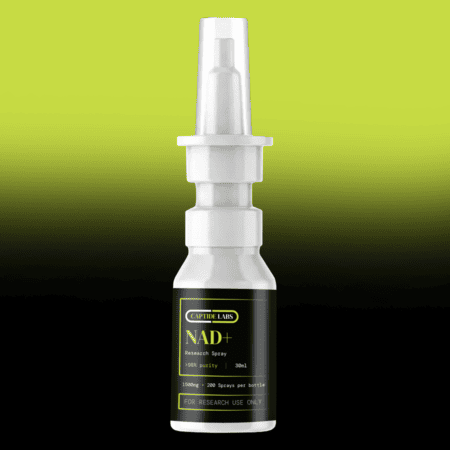
Capsule format. This product is supplied by Captide Labs in capsule form, consistent with the brand’s capsule-first catalog. Researchers should note that NAD+ is a large, charged, and relatively unstable molecule, and its oral bioavailability and cellular uptake are a significant and actively debated research question — much of the supplementation literature uses precursors specifically because of NAD+’s own delivery limitations. Encapsulated oral delivery of NAD+ therefore represents a distinct and not-well-characterized research variable.
Stability and storage. NAD+ is supplied as a powder and is sensitive to moisture and heat; it is typically stored frozen, protected from light, with solutions prepared fresh and kept cold, as NAD+ degrades in aqueous solution over time. Each lot supplied by Captide Labs is accompanied by a batch-specific Certificate of Analysis documenting identity and purity by HPLC.
Adverse-event profile. As an endogenous coenzyme, NAD+ is not foreign to the body, but this does not establish a safety profile for supplemental administration at non-physiological amounts or by particular routes. No adequately powered long-term human clinical-trial adverse-event database exists for NAD+ supplementation, and safety for such use has not been established to a regulatory standard. The cancer-metabolism context noted above is relevant background.
References
- Xiao W, Wang RS, Handy DE, Loscalzo J. NAD(H) and NADP(H) Redox Couples and Cellular Energy Metabolism. Antioxid Redox Signal. 2018;28(3):251–272. doi:10.1089/ars.2017.7216 · PubMed: 28648096
- Verdin E. NAD+ in aging, metabolism, and neurodegeneration. Science. 2015;350(6265):1208–1213. doi:10.1126/science.aac4854 · PubMed: 26785480
- Navas LE, Carnero A. NAD+ metabolism, stemness, the immune response, and cancer. Signal Transduct Target Ther. 2021;6(1):2. doi:10.1038/s41392-020-00354-w · PubMed: 33384409