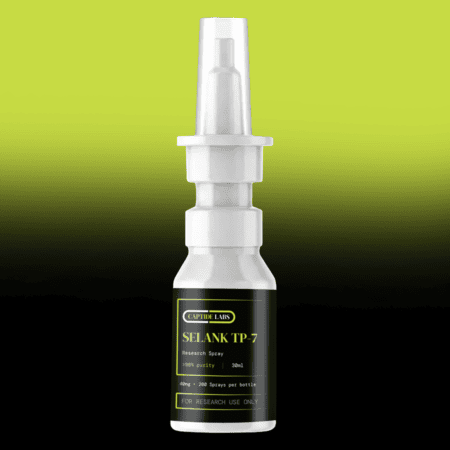
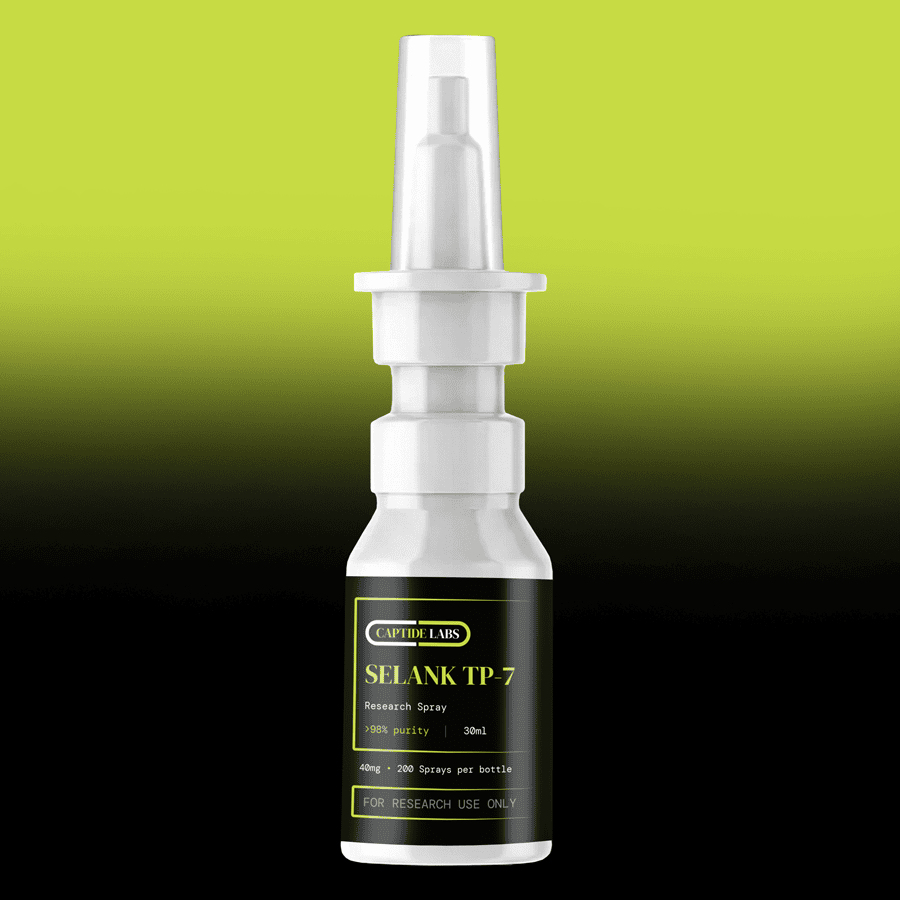
Selank TP-7 Spray
$109.99
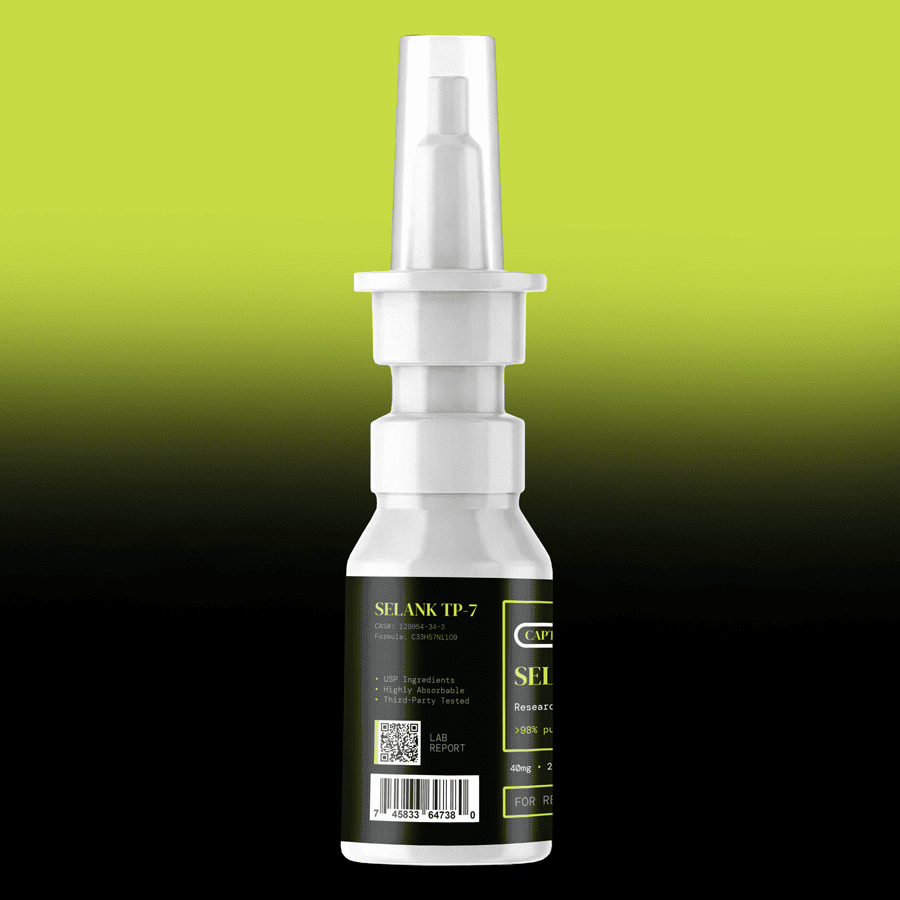
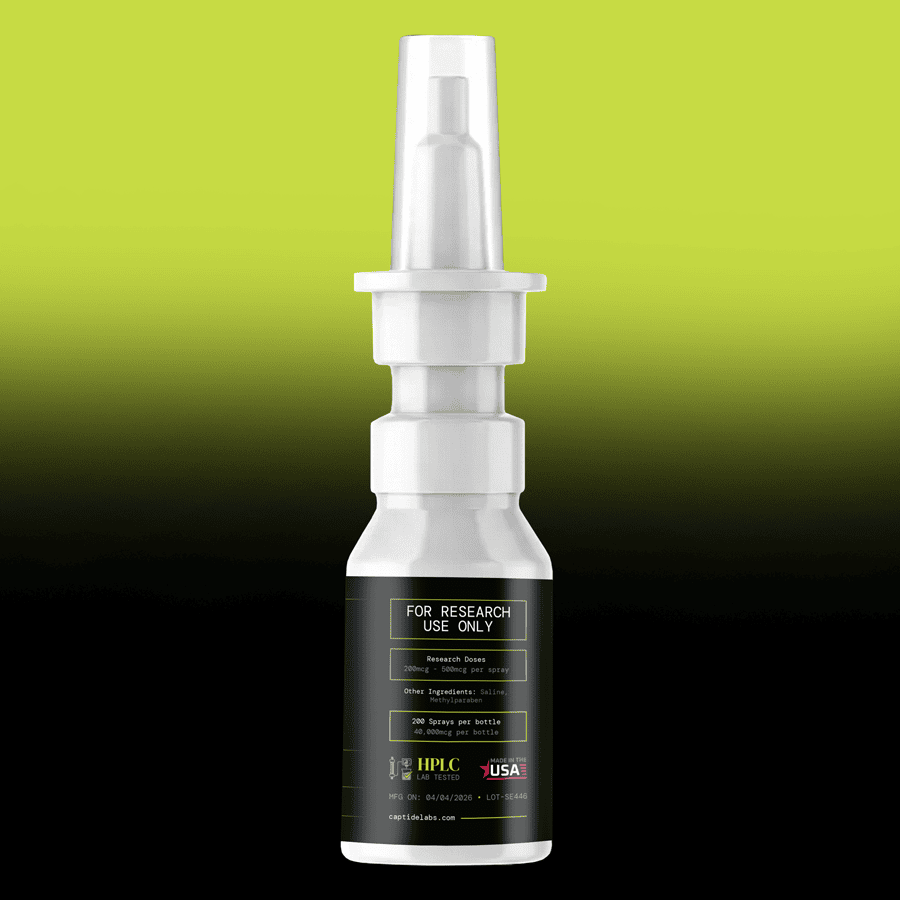
Selank TP-7 research spray — 40mg per 30ml bottle, 200–500mcg per actuation. Tuftsin-derived anxiolytic neuropeptide. CAS 129954-34-3. Approved in Russia for anxiety and neurasthenia. Third-party tested, ISO 17025 verified. For research use only.

- Description
- FDA Disclosure & Intended Use
- Storage Instructions
- Reviews (0)
- Research Use Only (RUO) Policy
Description
Description
Selank TP-7 Research Spray | Anxiolytic Tuftsin Analogue & Nootropic Heptapeptide
Captide Labs Selank TP-7 Spray delivers research-grade Selank in a pre-formulated, ready-to-use liquid spray format. Each 30ml bottle contains 40mg of Selank at greater than 98% purity, independently verified by HPLC-MS analysis and documented with a full Certificate of Analysis. Concentration is 1.33mg/ml, with each actuation delivering approximately 200–500mcg depending on application protocol.
Selank (CAS 129954-34-3, also designated TP-7) is a synthetic heptapeptide analogue of tuftsin (Thr-Lys-Pro-Arg) — an endogenous immunomodulatory tetrapeptide derived from the Fc region of immunoglobulin G. Selank extends the tuftsin core with a Pro-Gly-Pro C-terminal motif that shields it from aminopeptidase degradation and improves blood-brain-barrier permeability. Developed in the 1990s at the Institute of Molecular Genetics of the Russian Academy of Sciences under Nikolai F. Myasoedov, Selank is approved in Russia as a prescription 0.15% nasal spray for generalized anxiety disorder and neurasthenia — making it one of the few research peptides to have achieved full regulatory approval for a neurological indication. Russian clinical trials reported anxiolytic efficacy comparable to the benzodiazepine medazepam, without the sedation, tolerance, or dependence profile associated with that drug class.
What is Selank?
Selank (TP-7) is a synthetic heptapeptide with the sequence Thr-Lys-Pro-Arg-Pro-Gly-Pro (TKPRPGP). It was developed as a stabilized analogue of tuftsin — a naturally occurring tetrapeptide (Thr-Lys-Pro-Arg) cleaved from the heavy chain of immunoglobulin G, known primarily for its immunomodulatory effects on macrophages and neutrophils. Tuftsin on its own has a plasma half-life measured in seconds because aminopeptidases cleave it rapidly. The Pro-Gly-Pro C-terminal extension added in Selank’s design dramatically slows that degradation and also improves blood-brain-barrier permeability — which is why the compound is delivered intranasally rather than orally in research and clinical applications.
Developed at the Institute of Molecular Genetics of the Russian Academy of Sciences under Nikolai F. Myasoedov, Selank is approved in Russia as a prescription 0.15% nasal spray for anxiety disorders and neurasthenia — making it one of the few research peptides to have undergone full clinical development and obtained regulatory approval. Human clinical trials (Zozulya et al., 2008) demonstrated anxiolytic efficacy comparable to medazepam, without the sedation, tolerance, or dependence profile associated with the benzodiazepine class. Outside Russia and Eastern Europe, Selank is distributed as a research compound with a triple pharmacological profile spanning anxiolytic, nootropic, and immunomodulatory mechanisms.
Areas of Active Selank Investigation
GABAergic Modulation & Anxiolytic Signaling
Selank’s anxiolytic effects appear to be primarily mediated through GABAergic pathways. Studies have demonstrated that Selank influences GABA-A receptor function and modulates the expression of genes involved in GABAergic neurotransmission, producing benzodiazepine-comparable anxiolytic effects without sedation. A landmark 2008 clinical trial (Zozulya et al.) compared Selank directly to medazepam in patients with generalized anxiety disorder and neurasthenia, finding comparable anxiolytic efficacy with additional psychostimulant and antiasthenic properties in the Selank group — a profile not seen with benzodiazepines.
Enkephalinase Inhibition & Endogenous Opioid Tone
Selank potently inhibits enkephalinase enzymes — specifically the enzymes responsible for degrading endogenous enkephalins (small opioid-like neuropeptides involved in pain modulation, mood, and stress response). By slowing enkephalin breakdown, Selank enhances the body’s natural opioid-like signaling without directly binding opioid receptors. This mechanism is shared with Semax and is thought to contribute to both the anxiolytic and mood-regulating effects observed in preclinical models, while explaining the absence of tolerance and dependence typical of direct opioid receptor agonism.
BDNF Modulation & Neuroplasticity
Intranasal Selank has been shown to increase BDNF expression in the hippocampus in preclinical models, supporting neuroplasticity and potentially contributing to its sustained cognitive and anxiolytic effects. Researchers have examined Selank’s influence on the transcription of neurotrophins and their receptor genes in the context of stress models, with findings suggesting that BDNF upregulation may underlie the protective cognitive effects observed in studies on learning and memory in both normal and alcohol-impaired subjects.
Monoaminergic Neurotransmitter Research
Selank modulates the brain’s serotonergic, dopaminergic, and noradrenergic systems. Studies have documented increased serotonin turnover and potentiation of noradrenergic signaling following Selank administration. This broad monoaminergic activity profile makes it a useful research tool for investigating the interplay between these neurotransmitter systems in anxiety, mood regulation, motivation, and cognitive performance — and distinguishes it mechanistically from pure GABAergic anxiolytics.
Hippocampal Inhibitory Current Modulation
Cellular-level studies have characterized Selank’s effects on inhibitory postsynaptic currents (IPSCs) in the rat hippocampal CA1 region — a key brain area for memory formation and emotional regulation. At a concentration of 1 μM, Selank has been reported to increase both the amplitude and discharge rate of inhibitory postsynaptic currents in CA1 neurons. This electrophysiological signature is consistent with Selank’s behavioral anxiolytic profile and provides a mechanistic correlate for its observed effects in anxiety and stress models.
Immunomodulatory Research
As a tuftsin analogue, Selank retains and extends the immunomodulatory properties of its parent peptide. Preclinical studies have reported Selank-associated modulation of cytokine expression profiles — including effects on interleukin and interferon-related markers — making it a useful tool for investigating the intersection of peptide-mediated neuroimmune signaling and immune regulation. Researchers have also examined Selank in models of metabolic syndrome, where it has demonstrated effects on anticoagulation system functionality and fat accumulation markers.
Frequently Asked Questions
What is Selank used for in research?
What is the concentration of this spray?
How does Selank relate to tuftsin?
What is the CAS number for Selank?
How does Selank differ from benzodiazepines in research models?
How should Selank TP-7 Spray be stored?
For research use only. Not for human consumption, veterinary use, or food/agricultural applications. Not evaluated or approved by the FDA. Not intended to diagnose, treat, cure, or prevent any condition. All purchases are made with the understanding that this compound is strictly for in-vitro research and laboratory use. See the full Research Use Only (RUO) Policy.
FDA Disclosure & Intended Use
FDA Disclosure: The statements on this website and the products sold herein have not been evaluated by the U.S. Food and Drug Administration (FDA). These products are not intended to diagnose, treat, cure, or prevent any disease. Products sold are for Research Use Only and are not for human or animal use.
Intended Purpose: Products sold on this site are intended solely for basic laboratory research, pharmaceutical research, or the development of new tests. They are not intended for diagnostic, therapeutic, or clinical use.
Storage Instructions
Handling and Storage Tips:
- Keep peptides cold and away from light once received.
- For short-term use (days to weeks), refrigeration at 4°C (39°F) is acceptable.
- Lyophilized peptides are typically stable at room temperature for several weeks, making it suitable for moderate-term storage.
- For long-term storage (months to years), it’s best to freeze peptides at -80°C (-112°F). Freezing optimally preserves peptide stability for extended periods.
Reviews (0)
Total reviews
Persons recommended this product
Anonymous
Shopper
check_circle Verified
Shop owner replied
Anonymous
Shopper
check_circle Verified
Shop owner replied
There are no reviews yet.
Be the first to review “ ”
Thanks for your review!
Your feedback helps us improve our service.
Research Use Only (RUO) Policy
"RUO" is an abbreviation for Research Use Only. It is a designation used primarily by the FDA (Food and Drug Administration) for products, often in vitro diagnostic (IVD) components like reagents or instruments, that are in the laboratory research phase of development and are not intended for clinical diagnostic use.
READ MORE