Dihexa Capsules
$129.99
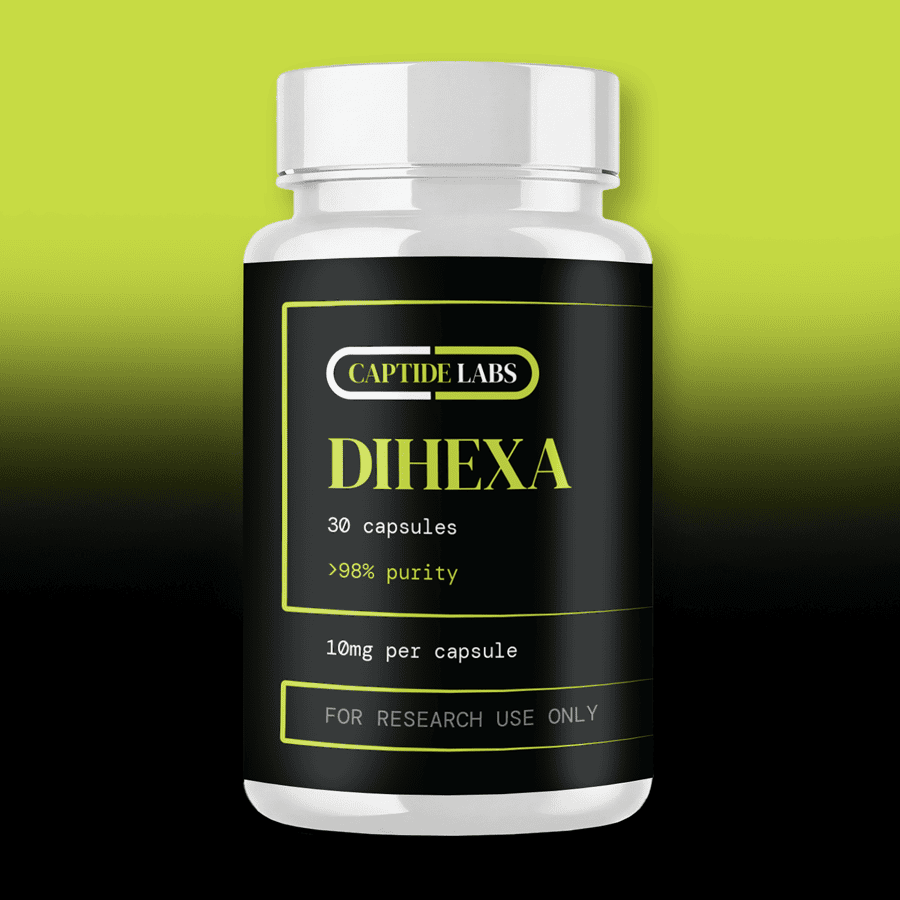
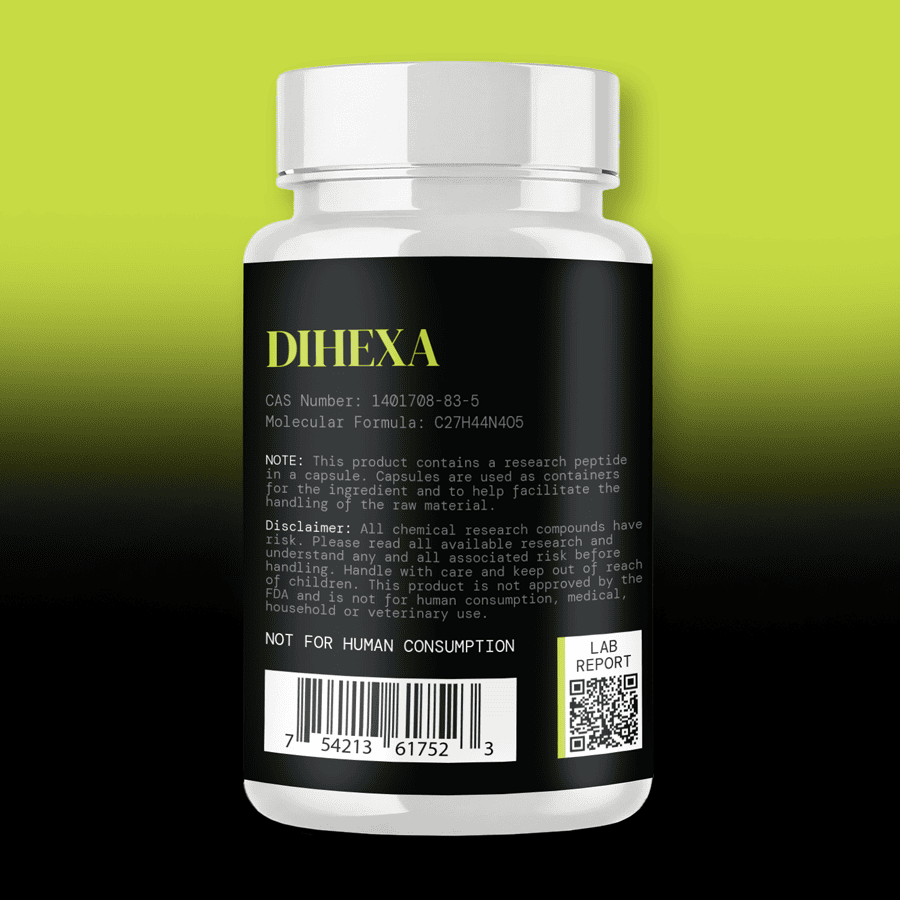
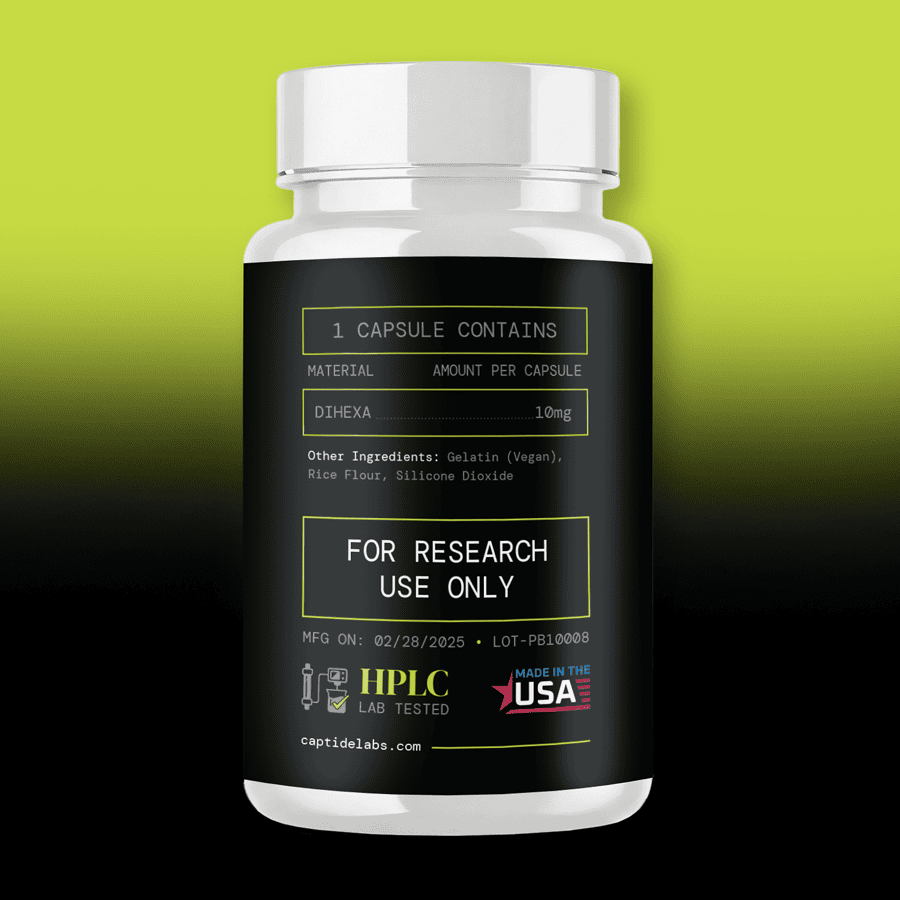
Research-grade Dihexa capsules. 10mg per capsule, 30 capsules per bottle. HPLC tested, >98% purity. CAS# 1401708-83-5. For research use only.

- Description
- FDA Disclosure & Intended Use
- Storage Instructions
- Reviews (0)
- Research Use Only (RUO) Policy
Description
Description
Dihexa Research Capsules | HGF/MET Potentiator & Procognitive Peptide
Captide Labs Dihexa capsules provide researchers with a precisely dosed, encapsulated format of one of the most potent cognition-related peptidomimetic compounds investigated in preclinical neuroscience research. Each capsule delivers 10mg of Dihexa at greater than 98% purity, independently verified by HPLC-MS analysis and documented with a full Certificate of Analysis.
Dihexa (CAS 1401708-83-5, also known as PNB-0408 or N-hexanoic-Tyr-Ile-(6) aminohexanoic amide) is a small oligopeptide derived from angiotensin IV (AngIV) and developed at Washington State University. It binds hepatocyte growth factor (HGF) with high affinity (Kd ≈ 65 pM) and potentiates HGF signaling at the c-Met receptor tyrosine kinase — a pathway with established roles in synaptogenesis, neuronal survival, and cognitive function. In published neurotrophic activity assays, Dihexa has been reported as several orders of magnitude more potent than BDNF in hippocampal spinogenesis models.
What is Dihexa?
Dihexa is a small peptidomimetic compound derived from angiotensin IV (AngIV), developed at Washington State University through structure-activity relationship studies aimed at identifying potent HGF/MET pathway modulators. It was specifically designed to penetrate the blood-brain barrier — a significant challenge for peptide-based neurological research compounds — while retaining potent biological activity at the c-Met receptor. Its IUPAC name is 6-[(2S,3S)-2-[(2S)-2-hexanamido-3-(4-hydroxyphenyl)propanamido]-3-methylpentanamido]hexanamide.
The HGF/MET signaling axis plays well-established roles in neuronal development, synaptic plasticity, and neuroprotection. Dihexa’s reported ability to potentiate HGF-mediated c-Met receptor activation — without activating c-Met on its own at the concentrations studied — has made it a subject of significant research interest in models of cognitive decline, neurodegeneration, and hippocampal function, particularly in conditions associated with reduced HGF/MET signaling such as Alzheimer’s disease research models.
Areas of Active Dihexa Investigation
HGF / c-Met Receptor Potentiation
Dihexa’s primary mechanism involves binding HGF with high affinity (reported Kd ≈ 65 pM) and potentiating its signaling at the c-Met receptor tyrosine kinase. Importantly, Dihexa at low nanomolar and picomolar concentrations does not activate c-Met on its own, but markedly augments the capacity of subthreshold HGF concentrations to activate the receptor — characterizing it as a positive allosteric potentiator rather than a direct agonist. Downstream signaling includes PI3K/Akt and MAPK/ERK pathway activation.
Synaptogenesis & Hippocampal Function
Preclinical studies from the Harding and Wright laboratories at Washington State University reported that Dihexa significantly increased dendritic spine density and synaptic connectivity in hippocampal neuron cultures, and improved performance in spatial learning tasks in rodent models. These findings positioned Dihexa as a uniquely potent tool compound for studying HGF-driven synaptogenesis and hippocampal-dependent memory formation.
Cognitive Decline & Alzheimer’s Disease Models
Animal models of age-related cognitive decline and chemically-induced memory impairment have been used to investigate Dihexa’s effects on learning and memory. Researchers have examined its potential to restore cognitive function in scopolamine-induced amnesia models and in aged rodent models with documented hippocampal-dependent memory deficits. It has been characterized in the literature as a procognitive/antidementia tool compound.
Blood-Brain Barrier Penetration & Oral Bioavailability
A key research interest is Dihexa’s lipophilicity and reported ability to cross the blood-brain barrier following peripheral administration, including oral dosing. Researchers have studied its CNS bioavailability compared to parent AngIV analogues — which themselves cross the BBB poorly — and its long circulating half-life that supports once-daily dosing protocols in animal models.
Neuroprotection & Neuronal Survival
HGF/c-Met signaling is a well-characterized neuroprotective pathway in central and peripheral nervous system research. Researchers have investigated Dihexa in models of oxidative stress-induced neuronal death and chemically-induced neurotoxicity, examining whether MET potentiation is sufficient to activate pro-survival PI3K/Akt signaling in neurons under conditions mimicking neurodegenerative pathology.
Neurotrophic Comparison Studies
Published neurotrophic activity assays from the original developing laboratory reported Dihexa as several orders of magnitude more potent than brain-derived neurotrophic factor (BDNF) in hippocampal spinogenesis models. This has made Dihexa a benchmark tool compound for researchers comparing the relative potency of small-molecule versus protein-based neurotrophic signaling agents in CNS regeneration research.
Frequently Asked Questions
What is Dihexa used for in research?
What is Dihexa’s mechanism of action?
What purity is Captide Labs Dihexa?
What is the CAS number for Dihexa?
How does Dihexa compare to BDNF in neurotrophic potency?
How is the purity of Captide Labs Dihexa verified?
For research use only. Not for human consumption, veterinary use, or food/agricultural applications. Not evaluated or approved by the FDA. Not intended to diagnose, treat, cure, or prevent any condition. All purchases are made with the understanding that this compound is strictly for in-vitro research and laboratory use. See the full Research Use Only (RUO) Policy.
FDA Disclosure & Intended Use
FDA Disclosure: The statements on this website and the products sold herein have not been evaluated by the U.S. Food and Drug Administration (FDA). These products are not intended to diagnose, treat, cure, or prevent any disease. Products sold are for Research Use Only and are not for human or animal use.
Intended Purpose: Products sold on this site are intended solely for basic laboratory research, pharmaceutical research, or the development of new tests. They are not intended for diagnostic, therapeutic, or clinical use.
Storage Instructions
Handling and Storage Tips:
- Keep peptides cold and away from light once received.
- For short-term use (days to weeks), refrigeration at 4°C (39°F) is acceptable.
- Lyophilized peptides are typically stable at room temperature for several weeks, making it suitable for moderate-term storage.
- For long-term storage (months to years), it’s best to freeze peptides at -80°C (-112°F). Freezing optimally preserves peptide stability for extended periods.
Reviews (0)
Total reviews
Persons recommended this product
Anonymous
Shopper
check_circle Verified
Shop owner replied
Anonymous
Shopper
check_circle Verified
Shop owner replied
There are no reviews yet.
Be the first to review “ ”
Thanks for your review!
Your feedback helps us improve our service.
Research Use Only (RUO) Policy
"RUO" is an abbreviation for Research Use Only. It is a designation used primarily by the FDA (Food and Drug Administration) for products, often in vitro diagnostic (IVD) components like reagents or instruments, that are in the laboratory research phase of development and are not intended for clinical diagnostic use.
READ MORE