PT-141 Spray
$129.99
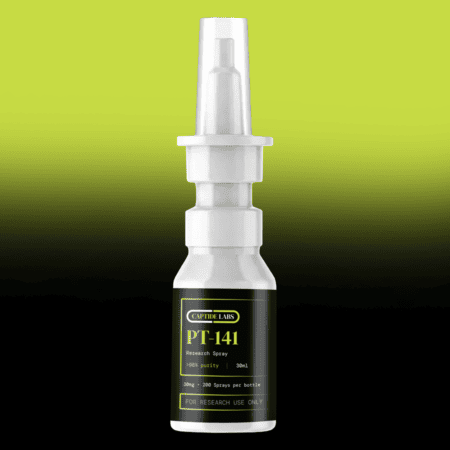
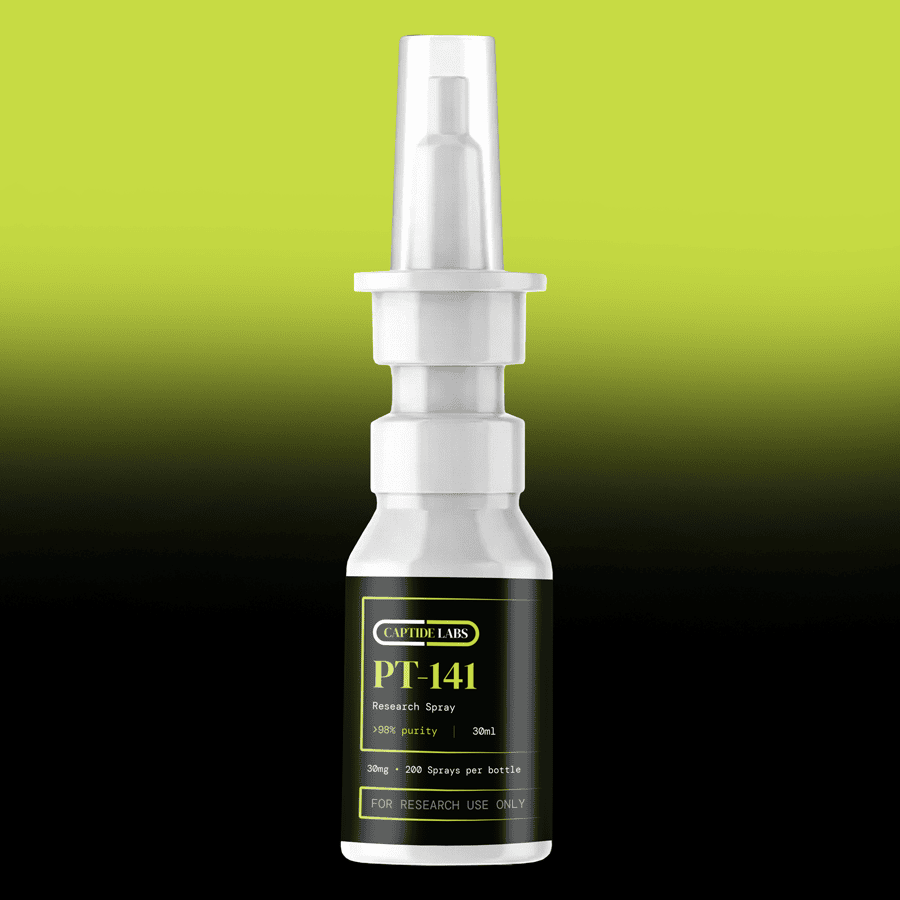
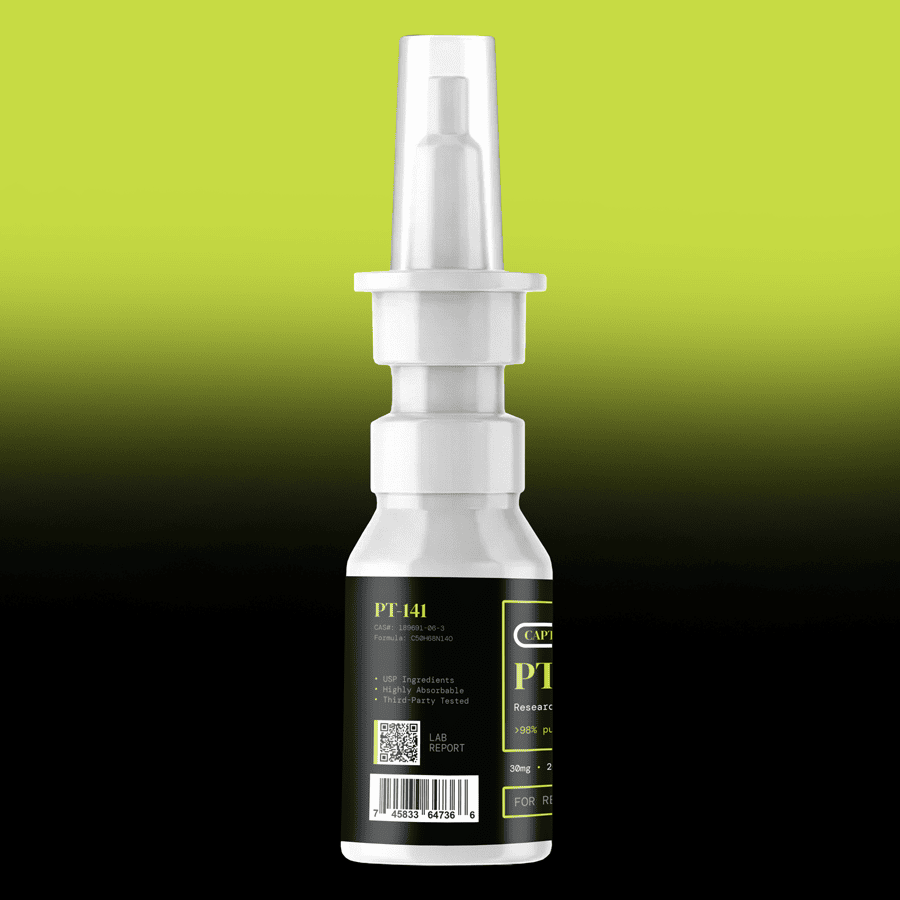
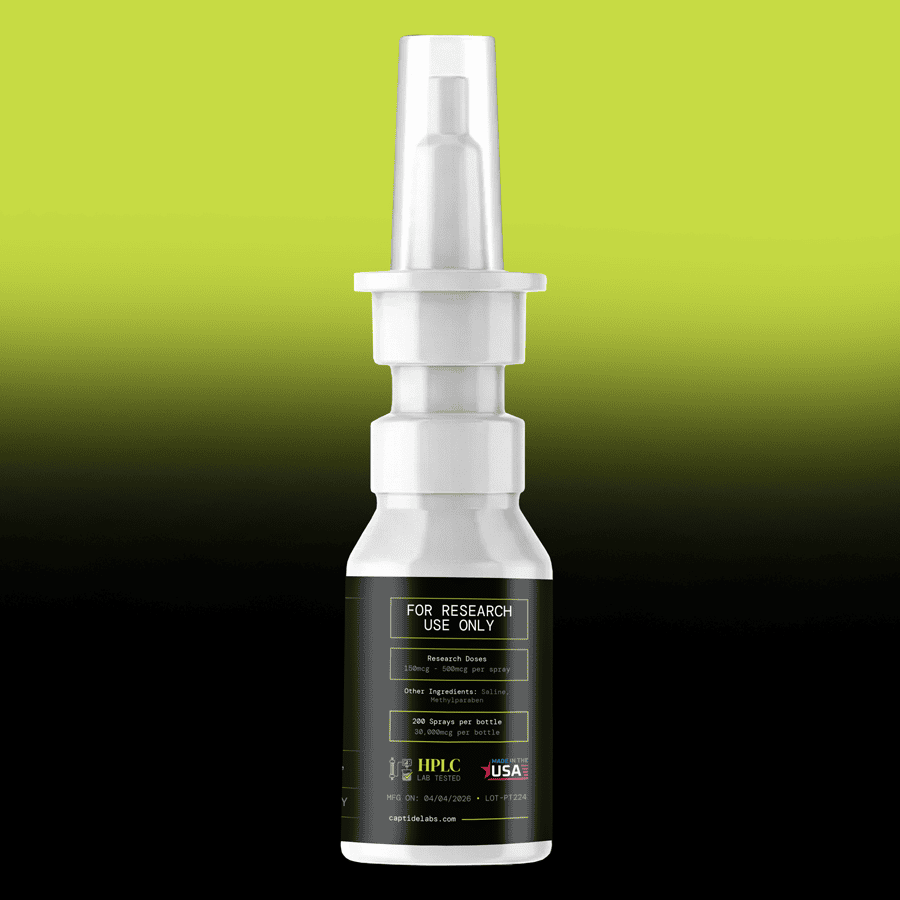
PT-141 (Bremelanotide) research spray — 30mg per 30ml bottle, 150–500mcg per actuation. Cyclic heptapeptide melanocortin receptor agonist. CAS 189691-06-3. HPLC-MS tested, >98% purity. Third-party tested, ISO 17025 verified. For research use only.

- Description
- FDA Disclosure & Intended Use
- Storage Instructions
- Reviews (0)
- Research Use Only (RUO) Policy
Description
Description
PT-141 Research Spray | Bremelanotide & Melanocortin Receptor Agonist
Captide Labs PT-141 Spray delivers research-grade Bremelanotide in a pre-formulated, ready-to-use liquid spray format. Each 30ml bottle contains 30mg of PT-141 at greater than 98% purity, independently verified by HPLC-MS analysis and documented with a full Certificate of Analysis. Concentration is 1mg/ml, with each actuation delivering approximately 150–500mcg depending on application protocol.
PT-141 (CAS 189691-06-3, also known as Bremelanotide) is a brain-penetrant synthetic cyclic heptapeptide derived from α-MSH (alpha-melanocyte stimulating hormone). It functions as a broad melanocortin receptor agonist with documented activity at MC1R, MC3R, MC4R, and MC5R — with reported MC4R binding affinity of approximately 10 nM. PT-141 was approved by the FDA in June 2019 as Bremelanotide (Vyleesi) for hypoactive sexual desire disorder (HSDD) in premenopausal women — making it one of the few research peptides in the contemporary catalog with an approved clinical indication.
What is PT-141?
PT-141 (Bremelanotide) is a synthetic cyclic heptapeptide derived from Melanotan II research. It is a brain-penetrant melanocortin receptor agonist with documented activity at multiple melanocortin receptor subtypes (MC1R, MC3R, MC4R, MC5R) — with particular research interest in its MC4R activity, since MC4R is expressed extensively in the hypothalamus and limbic system, brain regions involved in motivation, reward, and arousal signaling. Unlike PDE5 inhibitors (sildenafil, tadalafil) which act peripherally on vascular smooth muscle, PT-141 acts centrally on neural circuits, representing a mechanistically distinct approach to sexual function research.
PT-141 was originally derived from Melanotan II development as a candidate for sexual function applications. Early Phase 2 intranasal studies in men with erectile dysfunction demonstrated statistically significant pro-erectile effects, and subsequent development pivoted to female sexual dysfunction — culminating in FDA approval of Bremelanotide (Vyleesi) on June 21, 2019 for hypoactive sexual desire disorder (HSDD) in premenopausal women. It remains one of the few CNS-active research peptides with a fully approved clinical indication, and continues to be studied in mechanism-of-action research that probes the melanocortin system’s role in arousal, mood, and reward circuitry.
Areas of Active PT-141 Investigation
Melanocortin Receptor Pharmacology
PT-141 is used as a brain-penetrant agonist probe for melanocortin receptor subtypes in receptor pharmacology research. Reported MC4R binding affinity is approximately 10 nM by competitive binding in HEK-293 cells, with downstream cAMP accumulation confirming functional agonism. Researchers use PT-141 to map ligand-receptor selectivity, second-messenger cascades, and downstream gene expression effects across the MC1R/MC3R/MC4R/MC5R subtype family, providing a well-characterized tool for dissecting melanocortin system function in controlled in vitro assays and animal models.
CNS-Mediated Sexual Arousal & Desire Pathways
PT-141 has one of the most robust clinical evidence bases of any research peptide for sexual function. Phase 2 and Phase 3 clinical trials (RECONNECT-1 and RECONNECT-2) demonstrated significant improvements in desire scores and satisfying sexual events versus placebo in women with HSDD. Earlier Phase 2 intranasal studies in men with erectile dysfunction demonstrated pro-erectile effects at approximately 50 μg/kg, establishing PT-141’s relevance to both male and female sexual function research models — with the bulk of regulatory and mechanistic data drawn from approximately 3,500 human subjects across 43 completed clinical studies.
Dopaminergic Signaling & Reward Circuitry
PT-141’s CNS mechanism appears to involve dopaminergic activation in the medial preoptic area (MPOA) — a hypothalamic region central to sexual behavior in multiple species. Research has examined how MC4R activation in these regions generates arousal signals through dopaminergic projections, and how this intersects with the mesolimbic reward system. This makes PT-141 a useful tool for studying the neurological basis of sexual desire and its connection to broader motivational and reward signaling circuits.
Melanocortin System & Energy Homeostasis
Beyond sexual function, the melanocortin system — and MC4R in particular — plays a well-established role in energy balance, feeding behavior, and metabolic regulation. MC3R and MC4R are both expressed in the hypothalamus and are involved in food intake regulation. PT-141’s brain-penetrant pharmacology makes it a useful tool in studies examining melanocortin pathway contributions to energy homeostasis, body weight regulation, and the intersection of metabolic and reproductive signaling.
Intranasal Peptide Delivery Research
PT-141 has a particularly rich intranasal delivery research history — Palatin’s earliest Phase 2 work in men used intranasal Bremelanotide, demonstrating bioactive systemic concentrations through nasal mucosa absorption. While the approved Vyleesi product uses subcutaneous administration, the nasal route remains an active research delivery method for the compound. Researchers studying intranasal peptide delivery use PT-141 as a reference compound for nasal absorption kinetics, bioavailability comparison, and CNS access via the olfactory pathway.
Frequently Asked Questions
What is PT-141 used for in research?
How does PT-141 differ from PDE5 inhibitors like Viagra?
What is the concentration of this spray?
What is the CAS number for PT-141?
How does PT-141 relate to Melanotan II?
Is PT-141 selective for MC4R?
How should PT-141 Spray be stored?
For research use only. Not for human consumption, veterinary use, or food/agricultural applications. While Bremelanotide is FDA-approved as Vyleesi (a separate, distinct pharmaceutical product), this research-grade material is not evaluated or approved by the FDA. Not intended to diagnose, treat, cure, or prevent any condition. All purchases are made with the understanding that this compound is strictly for in-vitro research and laboratory use. See the full Research Use Only (RUO) Policy.
FDA Disclosure & Intended Use
FDA Disclosure: The statements on this website and the products sold herein have not been evaluated by the U.S. Food and Drug Administration (FDA). These products are not intended to diagnose, treat, cure, or prevent any disease. Products sold are for Research Use Only and are not for human or animal use.
Intended Purpose: Products sold on this site are intended solely for basic laboratory research, pharmaceutical research, or the development of new tests. They are not intended for diagnostic, therapeutic, or clinical use.
Storage Instructions
Handling and Storage Tips:
- Keep peptides cold and away from light once received.
- For short-term use (days to weeks), refrigeration at 4°C (39°F) is acceptable.
- Lyophilized peptides are typically stable at room temperature for several weeks, making it suitable for moderate-term storage.
- For long-term storage (months to years), it’s best to freeze peptides at -80°C (-112°F). Freezing optimally preserves peptide stability for extended periods.
Reviews (0)
Total reviews
Persons recommended this product
Anonymous
Shopper
check_circle Verified
Shop owner replied
Anonymous
Shopper
check_circle Verified
Shop owner replied
There are no reviews yet.
Be the first to review “ ”
Thanks for your review!
Your feedback helps us improve our service.
Research Use Only (RUO) Policy
"RUO" is an abbreviation for Research Use Only. It is a designation used primarily by the FDA (Food and Drug Administration) for products, often in vitro diagnostic (IVD) components like reagents or instruments, that are in the laboratory research phase of development and are not intended for clinical diagnostic use.
READ MORE