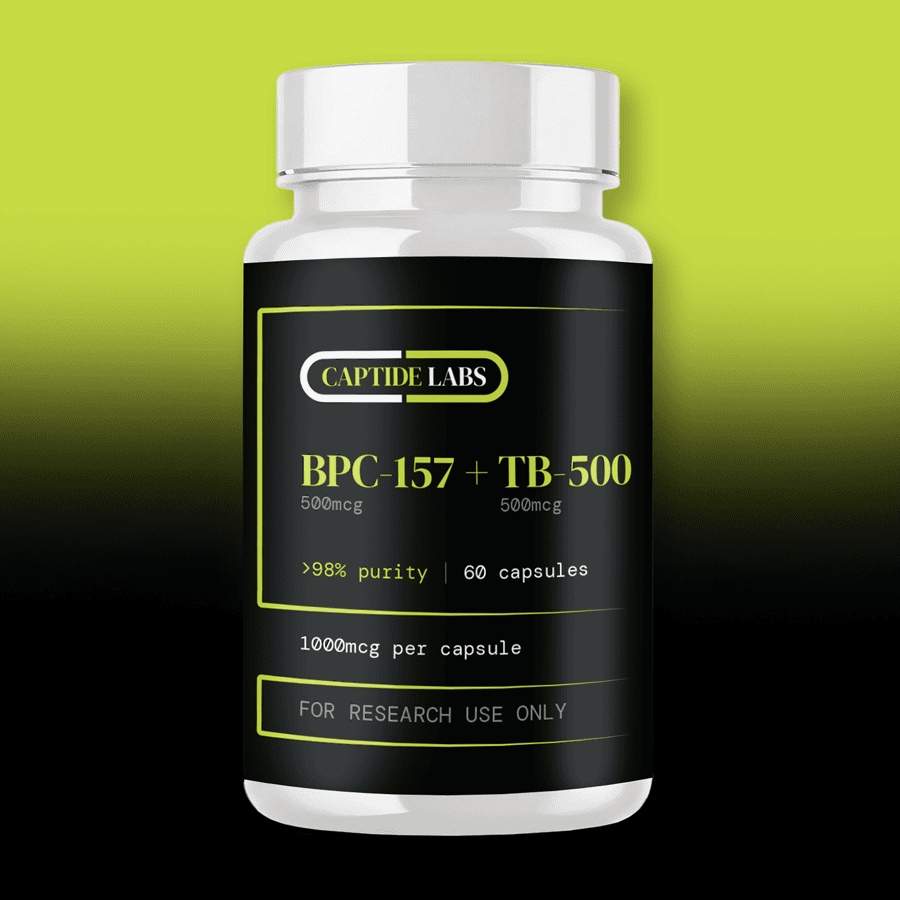
BPC-157 + TB-500 Blend Capsules
$119.99
A synergistic tissue repair peptide blend combining 500mcg BPC-157 (Body Protection Compound-157) and 500mcg TB-500 (Thymosin Beta-4) per capsule — 1mg total active content. Two complementary mechanisms: BPC-157’s NO/VEGF angiogenic signaling paired with TB-500’s actin-binding cytoskeletal remodeling. >98% HPLC-MS verified, ISO 17025 third-party tested. 60 capsules per bottle.

- Description
- FDA Disclosure & Intended Use
- Storage Instructions
- Reviews (1)
- Research Use Only (RUO) Policy
Description
Description
Skin & Recovery →·Performance →
BPC-157 + TB-500 Blend Research Capsules | Synergistic Tissue Repair Peptide Stack
Captide Labs BPC-157 + TB-500 Blend capsules combine two of the most extensively studied tissue repair peptides into a single precisely dosed encapsulated format. Each capsule delivers 500mcg of BPC-157 and 500mcg of TB-500 (1mg total active peptide content) at greater than 98% purity per active, independently verified by HPLC-MS analysis and documented with a full Certificate of Analysis.
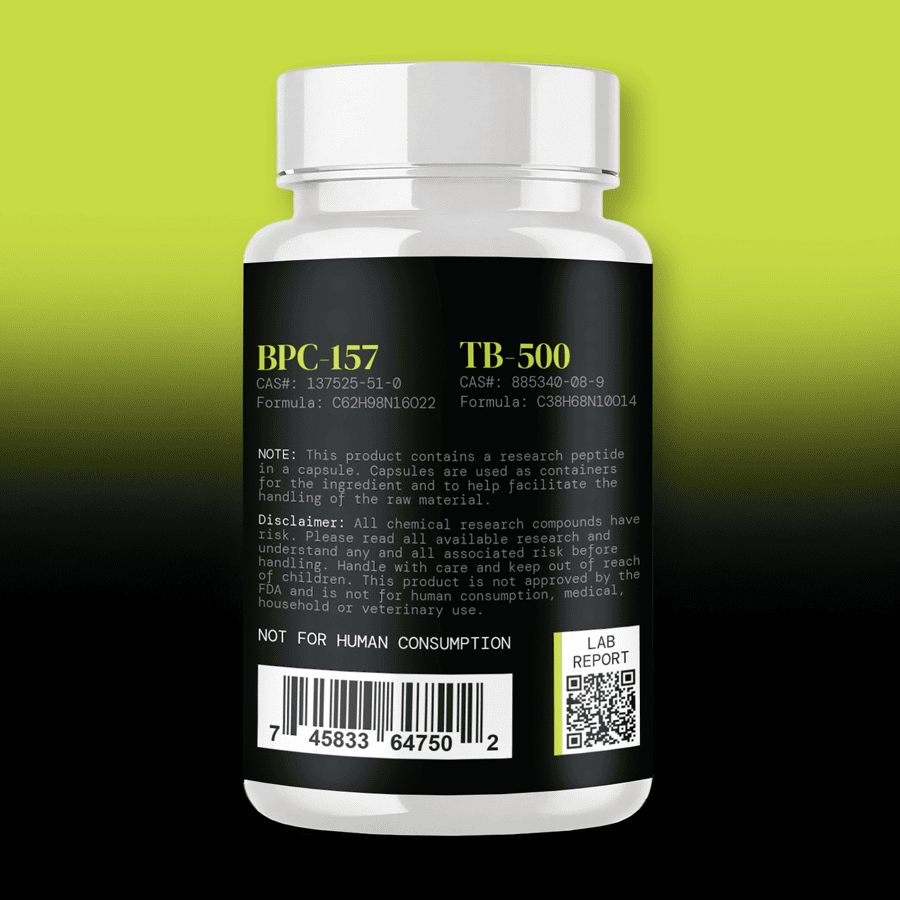
The combination of BPC-157 (Body Protection Compound-157, CAS 137525-51-0) and TB-500 (Thymosin Beta-4, CAS 77591-33-4) has become one of the most widely investigated dual-peptide stacks in tissue repair research. BPC-157 contributes broad-spectrum cytoprotective activity through nitric oxide modulation, VEGF/angiogenic signaling, and FAK-paxillin pathway activation, while TB-500 contributes actin-binding and cytoskeletal remodeling activity that supports cell migration, angiogenesis, and re-epithelialization — providing complementary mechanisms that researchers commonly co-investigate in connective tissue, musculoskeletal, and dermal repair models.
What’s in Each Capsule
A synthetic 15-amino acid pentadecapeptide derived from a protective protein found in human gastric juice. Sequence: Gly-Glu-Pro-Pro-Pro-Gly-Lys-Pro-Ala-Asp-Asp-Ala-Gly-Leu-Val. Molecular formula C₆₂H₉₈N₁₆O₂₂ (MW 1419.56 g/mol). Studied for tendon and ligament repair, gastrointestinal mucosal protection, angiogenesis via VEGF/NO pathway modulation, and systemic anti-inflammatory activity.
A 43-amino acid synthetic polypeptide identical to endogenous thymosin beta-4. Molecular formula C₂₁₂H₃₅₀N₅₆O₇₈S (MW 4963.44 g/mol). Studied for its actin-binding (G-actin sequestering) activity, promotion of endothelial cell differentiation, angiogenesis in dermal tissues, keratinocyte migration, collagen deposition, and inhibition of the Akt signaling pathway in fibrosis models.
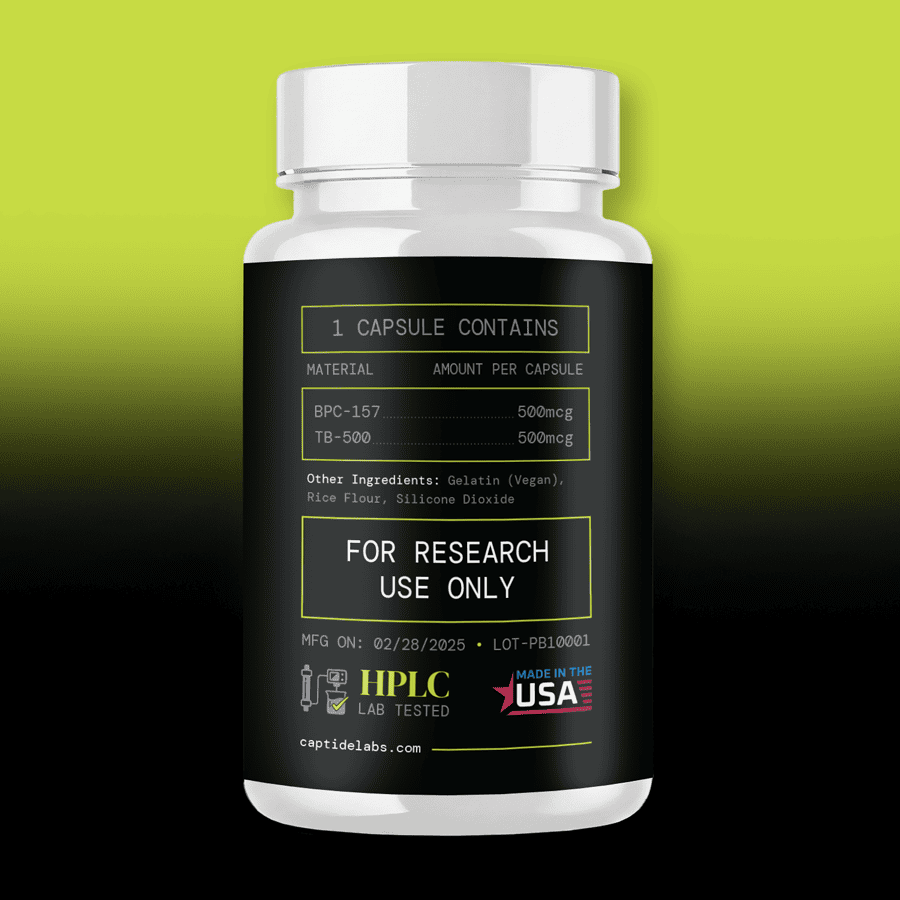
Each capsule contains 1mg of total active peptide content (500mcg BPC-157 + 500mcg TB-500) in a vegan gelatin capsule with rice flour and silicon dioxide excipients.
Why BPC-157 and TB-500 Are Studied Together
BPC-157 and TB-500 occupy overlapping but mechanistically distinct positions in the tissue repair research space. BPC-157 is a synthetic pentadecapeptide first characterized by Sikiric and colleagues at the University of Zagreb in the early 1990s, with documented activity across the nitric oxide system, VEGF upregulation, FAK-paxillin signaling, JAK2, and ERK1/2 pathways. TB-500, a synthetic version of thymosin beta-4, operates through a fundamentally different mechanism — direct binding to G-actin monomers, regulating actin polymerization dynamics that drive cell migration, neurite outgrowth, and endothelial cell behavior.
The two peptides converge on shared research endpoints — angiogenesis, wound healing kinetics, collagen organization, and anti-inflammatory signaling — while engaging different molecular machinery to reach them. This complementarity has made the BPC-157 + TB-500 combination one of the most commonly co-investigated peptide pairs in preclinical tissue repair research, particularly in models of tendon and ligament injury, dermal wound healing, gastrointestinal mucosal repair, and post-surgical recovery research. The encapsulated blend format provides researchers a consistent, pre-measured stack for studies designed to evaluate combined pathway effects.
Areas of Active BPC-157 + TB-500 Co-Investigation
Tendon, Ligament & Musculoskeletal Repair
The BPC-157 + TB-500 combination has been investigated in animal models of tendon transection, ligament injury, and muscle tear repair. BPC-157’s documented effects on tenocyte proliferation and collagen organization complement TB-500’s actin-mediated cell migration support — providing two independent mechanistic angles on connective tissue regeneration in research models. Researchers have examined healing kinetics, histological collagen organization, and biomechanical recovery endpoints in dual-treatment protocols.
Angiogenesis & Vascular Remodeling
Both peptides converge on angiogenic signaling through different upstream mechanisms. BPC-157 has been shown to upregulate VEGF and modulate nitric oxide synthase activity, promoting tube formation in HUVEC cell models via ERK1/2 phosphorylation. TB-500 supports endothelial cell differentiation and migration through actin-mediated cytoskeletal remodeling. Combination studies have examined whether the dual mechanisms produce additive or synergistic effects on vascular network formation in wound healing models.
Dermal Wound Healing & Re-Epithelialization
In dermal wound healing research, the combination has been studied for effects on re-epithelialization kinetics, keratinocyte migration (a key TB-500 effect), collagen deposition, and inflammatory cell infiltration. Researchers have investigated whether the actin-remodeling activity of TB-500 accelerates the migratory phase of healing while BPC-157’s angiogenic and anti-inflammatory effects support tissue remodeling, providing complementary contributions to the wound healing cascade.
Gastrointestinal Mucosal & Anastomotic Healing
BPC-157 has one of the largest preclinical datasets for GI mucosal protection — including NSAID-induced ulcer models, cysteamine-colitis, and intestinal anastomosis healing. TB-500 has been studied for its effects on epithelial migration and tight junction integrity. The combination has been investigated in GI repair models to examine whether dual-mechanism support of mucosal barrier function and epithelial migration produces enhanced repair outcomes.
Anti-Inflammatory & Anti-Fibrotic Signaling
Both peptides have demonstrated anti-inflammatory activity in preclinical models through distinct mechanisms — BPC-157 modulates COX-2 and NF-κB signaling and pro-inflammatory cytokines, while TB-500 has been shown to exert anti-fibrotic effects partly through inhibition of the Akt signaling pathway. Researchers have examined the combination in fibrosis models to characterize whether dual-pathway modulation produces additive anti-fibrotic outcomes.
Post-Surgical Recovery Research Models
In preclinical post-surgical models, the BPC-157 + TB-500 combination has been investigated for effects on overall recovery kinetics including wound tensile strength, scar formation, range of motion preservation in connective tissue injury models, and reduction of post-operative adhesion formation. Researchers have used the combination as a tool stack for studying multi-pathway recovery interventions.
Frequently Asked Questions
What is the BPC-157 + TB-500 blend used for in research?
Why use BPC-157 and TB-500 together?
What is the exact dose per capsule?
What purity is Captide Labs BPC-157 + TB-500 Blend?
What are the CAS numbers for BPC-157 and TB-500?
How is the purity of the BPC-157 + TB-500 Blend verified?
For research use only. Not for human consumption, veterinary use, or food/agricultural applications. Not evaluated or approved by the FDA. Not intended to diagnose, treat, cure, or prevent any condition. All purchases are made with the understanding that this compound is strictly for in-vitro research and laboratory use. See the full Research Use Only (RUO) Policy.
FDA Disclosure & Intended Use
FDA Disclosure: The statements on this website and the products sold herein have not been evaluated by the U.S. Food and Drug Administration (FDA). These products are not intended to diagnose, treat, cure, or prevent any disease. Products sold are for Research Use Only and are not for human or animal use.
Intended Purpose: Products sold on this site are intended solely for basic laboratory research, pharmaceutical research, or the development of new tests. They are not intended for diagnostic, therapeutic, or clinical use.
Storage Instructions
Handling and Storage Tips:
- Keep peptides cold and away from light once received.
- For short-term use (days to weeks), refrigeration at 4°C (39°F) is acceptable.
- Lyophilized peptides are typically stable at room temperature for several weeks, making it suitable for moderate-term storage.
- For long-term storage (months to years), it’s best to freeze peptides at -80°C (-112°F). Freezing optimally preserves peptide stability for extended periods.
Reviews (1)
Total reviews
Persons recommended this product
Anonymous
Shopper
check_circle Verified
Shop owner replied
Anonymous
Shopper
check_circle Verified
Shop owner replied
There are no reviews yet.
Be the first to review “ ”
Thanks for your review!
Your feedback helps us improve our service.
Research Use Only (RUO) Policy
"RUO" is an abbreviation for Research Use Only. It is a designation used primarily by the FDA (Food and Drug Administration) for products, often in vitro diagnostic (IVD) components like reagents or instruments, that are in the laboratory research phase of development and are not intended for clinical diagnostic use.
READ MORE